
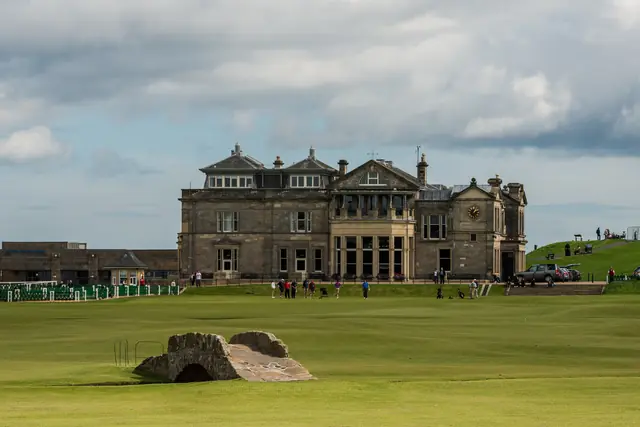

The story and its setting
Old Tom Morris and Young Tom Morris won eight Opens between them, but the family’s place in golf cannot be reduced to that combined total. The father helped shape courses, made equipment and maintained links while competing at the highest level. The son turned that inherited golfing world into a remarkable championship career of his own. Their story runs between St Andrews and Prestwick, joining the working life of nineteenth-century golf with the emergence of its most durable tournament. Following the two men means looking at how golf was played and supported, as well as who won.
Old Tom: a working life in golf
Tom Morris was born in St Andrews on 16 June 1821. The Open’s bicentenary account describes his early connection with the links and his work with Allan Robertson, an outstanding golfer and equipment maker. This was a setting in which playing, caddying and making the things required for golf could overlap. Old Tom’s later career should not be projected backwards into a modern division between touring professional, club professional, greenkeeper and course architect. His influence came partly from operating across those different responsibilities.
Prestwick recruited him in 1851 as Keeper of the Green, Ball and Clubmaker. The club’s own history identifies those duties and the family’s move from St Andrews. Morris laid out its original twelve-hole course, giving him a connection to the ground that was both competitive and practical. When the first Open was played there in 1860, he was contesting a championship on links he had helped create and cared for. Willie Park Snr nevertheless won, finishing two strokes ahead. Familiarity with the course did not settle the result.
Winning, defending and being challenged
Morris won the second Open in 1861. Unlike the inaugural professional-only contest, this edition admitted amateurs, although the professionals remained well ahead. Morris and Park were level after the first circuit of twelve holes; Park went two strokes ahead after the second. Morris reversed that position over the final round and finished with 163, four strokes clear. The result is a useful reminder that a championship played over three short circuits could still contain distinct changes of momentum.
His defence in 1862 was altogether more decisive. He again totalled 163 but won by thirteen strokes, the largest winning margin in The Open’s record. The comparison between those two scores matters: an identical aggregate produced a very different contest. The official account also records the limited field of eight, divided equally between professionals and amateurs. The achievement is substantial without pretending that the event had the scale or international entry of a modern major. The champions table puts each result beside its venue and margin.
A third victory followed in 1864. Morris led after every round, scored 167 and finished two strokes ahead of Andrew Strath. It was the first edition at which the champion received a financial prize, with £6 accompanying the year’s possession of the belt. Strath’s second place also interrupted the familiar Morris–Park pairing at the top of the results. The early championship was developing, even while its small group of leading professionals continued to recur.
A return to St Andrews and a fourth title
Morris returned to work on the St Andrews links in 1864. Historic Environment Scotland identifies that appointment as a significant point in the course’s management, while The Open’s account describes his contribution to the greens and routing. The Old Course had a long history before him. It would be misleading to call him its sole original architect; the more interesting achievement was the way he worked on an inherited landscape and influenced its subsequent development.
His fourth Open came at Prestwick in 1867, after the move back across Scotland. He won by two strokes from Park and, at 46, became the oldest Open champion. The official edition report describes a borrowed driver-putter used to keep the ball beneath the wind. That small equipment detail gives the result a practical texture: the oldest champion’s success involved adapting the shot to conditions, rather than merely relying on experience as an abstract quality. His son finished fourth that year. Within twelve months the order within the family would change.
Young Tom takes the championship
Young Tom was born in St Andrews in 1851 but spent his childhood at Prestwick before the family returned to Fife. His first Open win, in 1868, came at seventeen. It remains the championship’s youngest winning age. The runner-up was his father, producing a result that makes the generational change unusually visible: the previous year’s champion was beaten by his own son.
The scoring shows how Young Tom established the victory. He opened with 51 over the twelve holes, followed it with 54, then closed in 49 for an aggregate of 154. Old Tom finished on 157. The father had actually moved one stroke ahead after the second round, so this was not a title secured before the finish. Young Tom’s final circuit settled the contest. The official 1868 archive preserves both the rounds and their competitive context.
A new level of scoring
Young Tom retained the title in 1869 and recorded The Open’s first hole-in-one. It came at Prestwick’s eighth, the Station Hole, where the blind green meant the spectators could see the finish of the shot before he could. The championship’s account identifies the hole and the event; no reconstruction of his private thoughts is needed to appreciate the unusual situation. This was one of the striking individual shots within a period of repeated championship success.
The 1870 edition supplied another extraordinary opening. Young Tom took three at the long first hole after holing a lengthy approach, then completed the opening round in 47. His next two rounds were 51 and 51, making 149 for the championship. He won by twelve strokes. Those figures belong to three rounds of a twelve-hole course, not to a modern eighteen-hole round or a 72-hole major. Keeping the format beside the numbers makes the performance intelligible without making an invalid comparison with today’s scoring records.
That third consecutive title secured permanent ownership of the Challenge Belt. The interruption in 1871 means that his four successive championship victories were not four consecutive calendar years. When play resumed in 1872, he won again. This time Davie Strath had led by five after the second round, before Young Tom’s closing 53 secured a three-stroke victory. His run therefore included a successful pursuit as well as overwhelming wins.
The championship moves and the story ends
The Open travelled to St Andrews in 1873, where Tom Kidd won. Young Tom did not add a fifth title on the family’s home links. In 1874 the championship moved again, to Musselburgh, and he finished second to Mungo Park. Four circuits of the nine-hole links made up that contest. It was Young Tom’s last Open appearance. Reading those results beside his earlier successes prevents the story from becoming a closed legend in which he could never be beaten.
His wife and baby died in 1875, and Young Tom himself died on Christmas Day that year, aged 24. Accounts often surround those deaths with the language of a broken heart; that is a traditional description, not a medical diagnosis established by a championship result. The documented dates and losses are moving enough. Old Tom lived until 1908, remaining closely associated with St Andrews long after his own Open wins. His final championship appearance had come in 1896.
The courses as a continuing legacy
Old Tom’s influence extended beyond the venues of his victories. Carnoustie’s official timeline credits him with creating its eighteen-hole course in 1873. At St Andrews, the New Course opened in 1895 during the later part of his working life. These connections help explain why his name appears in course histories even when a site did not stage one of his championship wins. Playing and shaping golf were intertwined in his career.
For a short historical journey, pair Prestwick with St Andrews, then consider Musselburgh as the setting of Young Tom’s final championship. The existing history of The Open explains the wider tournament and trophy story. Use the current venue information for access: these places preserve significant associations, but their present layouts and working arrangements should not be mistaken for a complete reconstruction of nineteenth-century golf.
Sources and useful official links
- Confirmed: official 1868 archive
- Confirmed: Official and historical background
- Confirmed: Official and historical background
- Confirmed: Official and historical background
- Confirmed: Official and historical background
- Confirmed: Official and historical background
- Confirmed: Official and historical background
- Confirmed: Official and historical background
- Confirmed: Official and historical background
- Confirmed: Official and historical background
- Confirmed: Official and historical background
- Confirmed: Official and historical background
- Confirmed: Official and historical background
- Confirmed: Official and historical background
- Confirmed: Official and historical background
- Confirmed: Official and historical background
- Confirmed: Official and historical background
- Confirmed: Official and historical background
- Confirmed: Official and historical background
- Confirmed: Official and historical background
- Confirmed: Official and historical background
Useful reading for your visit
Visit today
- St Andrews Old Course visitor guide
- The Open 2027 at St Andrews
- Where to stay for The Open 2027 at St Andrews
Some links earn us a small commission at no extra cost to you. Affiliate disclosure.