
A championship begins beside the railway
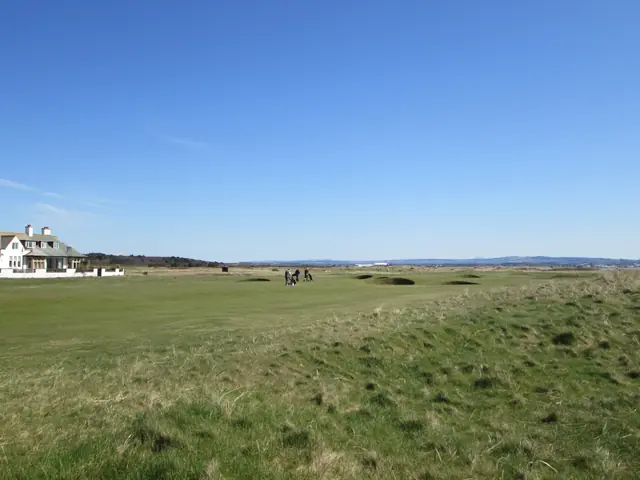
Prestwick's importance begins with a distinction that even a long list of famous champions cannot quite convey: this is where The Open first happened. The championship was a small gathering on a twelve-hole course before it became an international sporting institution. Its starting point remains unusually tangible. A stone cairn near the clubhouse marks the site of the original opening tee. The railway, the dunes and the confined stretch of coastal ground help explain the scale on which the earliest competitors played. This was golf rooted in a particular town and working landscape.
The club was founded in July 1851, with the Earl of Eglinton as its first captain. James Ogilvy Fairlie was central to bringing Tom Morris from St Andrews to serve the new venture. Morris combined responsibilities that would later become separate professions: maintaining the ground, making equipment and shaping the course itself. Prestwick therefore belongs in two histories at once. It helped establish a championship, but it also provided an important early setting for the career of the man now routinely called Old Tom. The club's history records that foundation and his appointment.
Old Tom and the original twelve holes
Morris's initial layout had twelve holes rather than eighteen. That number matters when reading the early results. The first championship comprised three circuits and thirty-six holes in total; its winning aggregate should not be compared directly with the four-round scores familiar today. Repeated journeys over a short course also meant that a player met the same hazards several times in a single competition. Local knowledge had an obvious practical value, although the inaugural result would show that Morris's familiarity offered no guarantee of victory.
His work at Prestwick lasted until 1864, when he returned to St Andrews. The relationship nevertheless continued beyond his employment. He helped with the later enlargement of the links, and his family became inseparable from its championship story. The survival of original greens is particularly revealing. Prestwick was altered as golf developed, yet the work did not require every early feature to disappear. Its present mixture of old ground and later routing gives the course a layered history rather than a single design date. The club's account of its professionals places Morris alongside the successors who maintained that continuity.
1860: eight professionals and a championship belt
On 17 October 1860, eight professionals contested the first Open. Willie Park Senior won with 174, two strokes ahead of Morris. The prize was a belt rather than the Claret Jug: red leather decorated with silver. Park's victory also established an enduring rivalry between the golfing communities of Musselburgh and St Andrews, played out here on the Ayrshire coast. A championship founded at Prestwick was international in ambition long before it was large in either field or audience.
The following year amateurs could compete, an important change to the meaning of an open championship. Morris won in 1861 and again in 1862; the latter victory came by thirteen strokes. Those results should be understood within their own format and field rather than treated as directly equivalent to modern major records. They nonetheless show how rapidly the new competition produced repeat champions and a recognisable sporting narrative. The official 1860 archive supplies the inaugural result, while the 1862 edition records Morris's commanding defence.
Young Tom changes the prize
Young Tom Morris won at Prestwick in 1868, 1869 and 1870. Three consecutive victories entitled him to keep the championship belt. The final performance in that sequence was particularly striking: 149 for thirty-six holes and a twelve-stroke winning margin. His success created an administrative problem as well as a sporting landmark. Once the trophy became his property, the championship needed a new prize and an agreement about who would provide it.
There was no Open in 1871. Prestwick, the Royal and Ancient Golf Club of St Andrews and the Honourable Company of Edinburgh Golfers then collaborated on the replacement trophy and a shared championship arrangement. Young Tom won again at Prestwick in 1872, before the new Claret Jug was ready. His name became the first engraved on it, although Tom Kidd, the 1873 winner at St Andrews, was the first champion to receive the completed trophy. The 1870 and 1872 official records explain why a trophy associated with every later venue has such strong roots here.
From twelve holes to eighteen
The enlargement to eighteen holes in 1882 was a substantial change, not simply a new championship label applied to the same circuit. Prestwick acquired additional ground and adapted its routing, retaining elements of the original links within a larger course. Its first Open on the eighteen-hole layout was played in 1884, when Jack Simpson won with 160. The championship still required only thirty-six holes, now achieved through two rounds rather than three.
This evolution is useful to remember when looking for the course of the earliest champions. A visitor is walking historical ground, but not following an unchanged 1860 itinerary. The club's original-links project makes that distinction explicit. In 2022 it recreated the twelve-hole layout to mark the playing of the 150th Open elsewhere in Scotland. That exercise was a way of investigating the past through the ground itself, restoring old relationships between tees, greens and hazards that a modern scorecard cannot fully explain.
The hazards that give Prestwick its character
Prestwick's named holes preserve an approach to links golf in which the landscape does not always reveal the whole problem from the tee. The Cardinal, Himalayas and Alps are central to its reputation. They require a player to interpret slopes and lines rather than expect every landing area and flag to be visible. That is part of the course's historical interest: its architecture records a different relationship between golfer and ground from the carefully exposed targets common in newer championship designs.
The seventeenth, the Alps, is the best-known example. The approach must negotiate a dune, with the Sahara bunker waiting beyond it. The difficulty is partly physical and partly informational. A well-struck shot can disappear from view before its outcome is known. The opening hole, alongside the railway, supplies a different kind of boundary and a reminder of how closely the links sit beside the town. The club's hole descriptions are the appropriate guide to today's routing; Golf Monthly's course review independently describes the surviving mixture of original features and distinctive blind shots.
Amateurs, professionals and a changing championship
John Ball's victory in 1890 gave Prestwick another important first: he became the first amateur to win The Open, as well as its first English champion. His 164 won by three strokes. It was the last Prestwick Open contested over thirty-six holes. By the time Willie Auchterlonie won here in 1893, the championship had expanded to seventy-two. The change doubles the number of strokes being counted and explains the apparent leap in winning aggregates.
Prestwick also provides a compact record of the great professional generation that followed. Harry Vardon won here in 1898, narrowly beating Willie Park Junior, and again in 1903. James Braid's 1908 victory came with 291 and an eight-stroke margin. Vardon returned to win his sixth and final Open in 1914, a championship total that remains unmatched. Read the 1890, 1908 and 1914 official editions together and the same links become a bridge between Victorian amateur golf and the increasingly established professional game.
1925: why the championship moved on
The last of Prestwick's twenty-four Opens was played in 1925. Macdonald Smith held a five-stroke lead after fifty-four holes but finished with 82. Jim Barnes, already in the clubhouse, won on 300, one ahead of Archie Compston and Ted Ray. The result is often remembered through Smith's difficult final round, yet Barnes still had to establish a score that the remaining contenders could not beat.
The R&A's account of 1925 also identifies the larger problem. A crowd of around 10,000 followed Smith, and the confined links could not comfortably accommodate the expanding event. Blind shots and the available space complicated the management of spectators. Prestwick's departure from the rota was therefore bound up with the championship's growth. The qualities that make a course fascinating for a small group of golfers do not automatically make it suitable for a huge gallery. Its historical standing survived the end of its hosting role.
Reading the course through its changes
The sequence of formats is worth carrying through the whole history. Three rounds of twelve holes became two rounds of eighteen, before the championship doubled to seventy-two holes. A comparison of winning aggregates without those changes would conceal more than it revealed. Equally, the continuing use of old greens does not imply that every champion faced precisely the same shots. Prestwick rewards a more careful kind of historical attention: recognising continuity in the land while allowing the championship, its equipment and its requirements to change. Its unusual features are evidence to investigate, rather than curiosities that need to be explained away.
A history that continued after The Open
Prestwick remained a serious competitive venue. Its Amateur Championship history includes John Ball's 1888 victory and Lawson Little's overwhelming success in 1934. Michael Hoey won the Amateur here in 2001. Those episodes prevent the course's story from ending with a disappointed gallery in 1925. Match play continued to test different strengths: recovery after a bad hole, the ability to win an individual contest and the patience to negotiate an old links under changing conditions.
The R&A's Amateur archive and the club's own honours history record those later championships. Together they also suggest a useful way to read Prestwick. It is a place where golf's institutions were made through practical decisions: how many holes to play, who could enter, what trophy to award and where spectators could safely stand. The surviving links give those decisions a physical setting. That makes its contribution larger than the sum of twenty-four winning names, even while those names remain the clearest chronological framework for understanding it.
Championships hosted
Championships at Prestwick appear below, bringing together the competitions covered in this History section. Qualifying courses are included.
| Year | Championship | Course | Champion or winning team | Source note | Sources |
|---|---|---|---|---|---|
| 1860 | The Open — 1 | Prestwick | Willie Park Snr | Official championship result | Official · Cross-check |
| 1861 | The Open — 2 | Prestwick | Old Tom Morris | Official championship result | Official · Cross-check |
| 1862 | The Open — 3 | Prestwick | Old Tom Morris | Official championship result | Official · Cross-check |
| 1863 | The Open — 4 | Prestwick | Willie Park Snr | Official championship result | Official · Cross-check |
| 1864 | The Open — 5 | Prestwick | Old Tom Morris | Official championship result | Official · Cross-check |
| 1865 | The Open — 6 | Prestwick | Andrew Strath | Official championship result | Official · Cross-check |
| 1866 | The Open — 7 | Prestwick | Willie Park Snr | Official championship result | Official · Cross-check |
| 1867 | The Open — 8 | Prestwick | Old Tom Morris | Official championship result | Official · Cross-check |
| 1868 | The Open — 9 | Prestwick | Young Tom Morris | Official championship result | Official · Cross-check |
| 1869 | The Open — 10 | Prestwick | Young Tom Morris | Official championship result | Official · Cross-check |
| 1870 | The Open — 11 | Prestwick | Young Tom Morris | Official championship result | Official · Cross-check |
| 1872 | The Open — 12 | Prestwick | Young Tom Morris | Official championship result | Official · Cross-check |
| 1875 | The Open — 15 | Prestwick | Willie Park Snr | Official championship result | Official · Cross-check |
| 1878 | The Open — 18 | Prestwick | Jamie Anderson | Official championship result | Official · Cross-check |
| 1881 | The Open — 21 | Prestwick | Bob Ferguson | Official championship result | Official · Cross-check |
| 1884 | The Open — 24 | Prestwick | Jack Simpson | Official championship result | Official · Cross-check |
| 1887 | The Open — 27 | Prestwick | Willie Park Jnr | Official championship result | Official · Cross-check |
| 1888 | The Amateur | Prestwick | John Ball Jr (Royal Liverpool) | Official championship result | Official · Cross-check |
| 1890 | The Open — 30 | Prestwick | John Ball Jnr | Official championship result | Official · Cross-check |
| 1893 | The Amateur | Prestwick | Peter Anderson (St Andrews University) | Official championship result | Official · Cross-check |
| 1893 | The Open — 33 | Prestwick | Willie Auchterlonie | Official championship result | Official · Cross-check |
| 1898 | The Open — 38 | Prestwick | Harry Vardon | Official championship result | Official · Cross-check |
| 1899 | The Amateur | Prestwick | John Ball Jr (Royal Liverpool) | Official championship result | Official · Cross-check |
| 1903 | The Open — 43 | Prestwick | Harry Vardon | Official championship result | Official · Cross-check |
| 1905 | The Amateur | Prestwick | A Gordon Barry (St Andrews University) | Official championship result | Official · Cross-check |
| 1908 | The Open — 48 | Prestwick | James Braid | Official championship result | Official · Cross-check |
| 1911 | The Amateur | Prestwick | Harold Hilton (Royal Liverpool) | Official championship result | Official · Cross-check |
| 1914 | The Open — 54 | Prestwick | Harry Vardon | Official championship result | Official · Cross-check |
| 1922 | The Amateur | Prestwick | Ernest Holderness (Walton Heath) | Official championship result | Official · Cross-check |
| 1925 | The Open — 60 | Prestwick | Jim Barnes | Official championship result | Official · Cross-check |
| 1928 | The Amateur | Prestwick | Philip Perkins (Castle Bromwich) | Official championship result | Official · Cross-check |
| 1934 | The Amateur | Prestwick | Lawson Little (USA) | Official championship result | Official · Cross-check |
| 1952 | The Amateur | Prestwick | Harvie Ward (USA) | Official championship result | Official · Cross-check |
| 1956 | British Masters | Prestwick | Christy Sr O'Connor | Official championship result | Official · Cross-check |
| 1987 | The Amateur | Prestwick/Prestwick St Nicholas | Paul Mayo (Newport) | Official championship result | Official · Cross-check |
| 2001 | The Amateur | Prestwick/Kilmarnock (Barassie) | Michael Hoey (Shandon Park) | Official championship result | Official · Cross-check |
Sources and useful official links
- Confirmed: The club's history
- Confirmed: its professionals
- Confirmed: official 1860 archive
- Confirmed: 1862 edition
- Confirmed: 1870
- Confirmed: 1872 official records
- Confirmed: club's original-links project
- Confirmed: club's hole descriptions
- Reported: Golf Monthly's course review
- Confirmed: 1890
- Confirmed: 1908
- Confirmed: 1914 official editions
- Confirmed: R&A's account of 1925
- Confirmed: R&A's Amateur archive
Useful reading for your visit
Visit today
Some links earn us a small commission at no extra cost to you. Affiliate disclosure.