
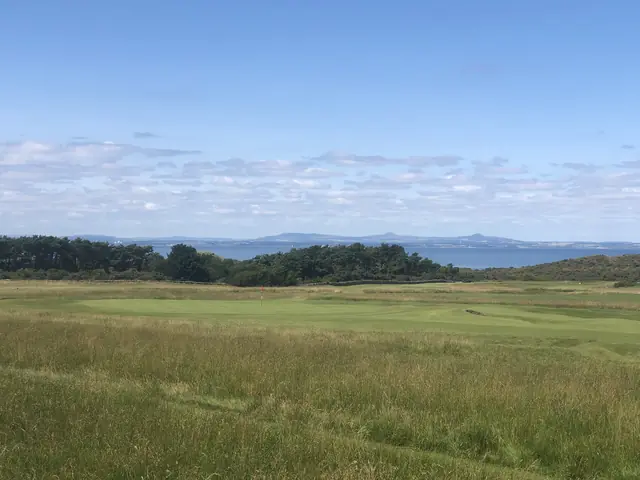

Nine holes with a much larger history
Musselburgh Old Links asks the reader to put aside a modern assumption: a championship course does not have to contain eighteen holes. Six Opens were played here between 1874 and 1889, each over four circuits of nine. The same compact ground could therefore produce a thirty-six-hole championship, a demanding play-off and a busy programme of ordinary club golf. Its historical importance lies partly in that repeated use. This was shared sporting ground before purpose-built championship infrastructure became an expectation.
The course survives within and around Musselburgh Racecourse, close to the town rather than isolated from it. That setting helps explain its past. Golfing clubs, professional players, tradespeople and other users competed for space on the links. The buildings along Balcarres Road preserve traces of the clubs that once gathered here. A visitor looking only for spectacular dunes could miss the point. Musselburgh's story is about how golf operated as part of a crowded community, and how that community helped shape the early Open.
What the early evidence actually proves
The secure documentary landmark is 2 March 1672. Sir John Foulis of Ravelston recorded playing golf at Musselburgh, including the money he lost in his match. The entry establishes an activity on this ground; it does not supply a modern foundation ceremony, a complete routing or a surviving scorecard. The distinction matters because statements about the world's oldest courses often combine different kinds of evidence. A record of play, the age of a club and the survival of particular holes are related questions, but they are not interchangeable.
Mary, Queen of Scots is frequently attached to an earlier date, 1567. That story should remain a tradition rather than a confirmed round on the present links. Scottish Golf History's examination of the claim points to evidence concerning nearby Seton and uncertainty about the precise game and location. The course operator likewise distinguishes documentary evidence from reputation. Musselburgh does not need the royal anecdote to justify its standing: the surviving seventeenth-century record is remarkable enough.
1874: Mungo Park wins the first Musselburgh Open
Mungo Park won the first Open held here with 159, two strokes ahead of Young Tom Morris. The official 1874 account describes a championship that changed considerably between its opening and closing circuits. Park established his advantage with 75 for the first eighteen holes. His second eighteen required 84, but the early work left a target the others could not quite reach.
It was a particularly meaningful result for the Park family. Willie Park Senior had won the inaugural Open at Prestwick; his brother now won at Musselburgh. Young Tom's challenge ended with costly mistakes near the finish, and this proved his final appearance in the championship. The result therefore sits at a turning point between famous generations. It also shows why a winning total alone can disguise the shape of a tournament: 159 was made from two very different halves, and protecting a lead mattered as much as establishing it.
1877: the beginning of Anderson's three in a row
Jamie Anderson's 1877 victory was the first of three successive Open wins. At Musselburgh he finished on 160, two ahead of Bob Pringle. He had been two strokes behind the leading group after eighteen holes, then produced a third circuit of 37 before finishing with 41. Bob Ferguson, a home favourite, could not convert his early position into victory.
The R&A's edition archive makes clear how a short circuit could create repeated changes in position. Four separate nines produced several opportunities to lose or recover ground, although the championship still ended within a single thirty-six-hole total. Anderson's win also broadens Musselburgh's story beyond its local champions. Visiting players could master the links, and the competition connected the town to the strongest golfers elsewhere in Scotland. Local identity was powerful, but the title remained open to someone who played better on the day.
1880: Ferguson claims his home championship
Ferguson succeeded in 1880, winning on 162 by five strokes from Peter Paxton. His round was not free of calamity. The official account records an eight at the second after trouble involving the road and a telegraph pole. He nevertheless recovered sufficiently to lead after eighteen holes and extended the advantage during the remaining circuits. One expensive hole did not settle a competition measured over thirty-six.
This was the first of Ferguson's three consecutive Opens. The success placed another Musselburgh player at the centre of the championship's developing history, alongside the Park family. It is tempting to treat such home victories as inevitable products of local knowledge. The actual sequence argues for a more interesting interpretation. Ferguson had to absorb a serious setback, continue scoring and outperform other local contenders who also knew the course. Familiarity supplied information; it did not eliminate the need to use it under pressure.
1883: the first Open play-off actually contested
Ferguson returned in 1883 seeking a fourth consecutive title. Willie Fernie prevented it, but only after an extraordinary recovery and an additional thirty-six holes. Fernie made a ten during regulation play and still tied Ferguson on 158. The championship's first play-off actually to be played then required four more circuits of the nine-hole links. A tied championship in 1876 had not produced a contested play-off because Davie Strath declined to take part.
At the closing hole of the 1883 play-off, Ferguson led by one. Fernie made two and Ferguson four, reversing the result at the last possible moment. Fernie won the extra contest 158 to 159. The official narrative is a reminder that early championships could demand endurance as well as low scoring. It also provides one of Musselburgh's strongest claims to a place in Open storytelling: an attempted fourth straight victory, a ten that failed to end the challenge and a final-hole reversal in a single event.
1886: David Brown's opportunity
David Brown won in 1886 with 157, two ahead of Willie Campbell. Stories about his last-minute arrival and borrowed clothing have become part of the town's golfing folklore. The firmer competitive evidence is equally worthwhile. Brown was close to the leaders after the opening eighteen, then made 37 on his third circuit and recovered from a difficult start to the final nine to finish strongly.
The official 1886 record describes Campbell's late bunker trouble and Brown's ability to keep his total within reach of victory. Brown subsequently continued a professional career beyond Scotland. His championship therefore illustrates another strand of Musselburgh's influence: players and golf skills developed in a relatively small town could travel much further. The Open table is a record of one day's achievement, but the people in it carried equipment knowledge, teaching and competitive experience into a widening golfing world.
1889: Park Junior and a final marathon
Willie Park Junior won the last Musselburgh Open in 1889 after tying Andrew Kirkaldy on 155. Their play-off added another thirty-six holes, with Park winning 158 to 163. It was his second Open title and brought the Park family's combined total to seven. Willie Senior had never won an Open on the home links, but Mungo and Willie Junior had both done so.
The R&A's account includes the practical difficulty of a November championship: daylight was scarce, and late finishers played by street lighting. Such details make the event feel very different from a modern summer Open. They also expose the organisational pressures behind the romance. Repeated circuits, a large field and limited daylight could make a small course difficult to manage. The final result was historic, but the mechanics of completing the competition were part of its history too.
The Open leaves, but the links endure
The Honourable Company moved to Muirfield in 1891, and the 1892 Open followed it there. Musselburgh's championship era ended because the organising club changed its home, not because golf stopped on the old ground. Royal Musselburgh remained until 1925 before moving to Prestongrange. Its club history also records the purchase of a hole-cutting implement in 1829, part of the local story behind golf's standard hole diameter. Conflicting published dates for the later adoption of that measurement make an unsupported exact year unhelpful here.
The present Musselburgh Old Course Golf Club dates from 1982. Its anniversary history describes local golfers organising to improve the course, initially using basic racecourse premises before acquiring and restoring a historic clubhouse in 1995. That more recent effort deserves a place beside the Victorian champions. Survival required people to value ordinary play as well as famous anniversaries. Musselburgh remains historically compelling because its ground continues to be used, negotiated and cared for: the same underlying relationship between town, golfers and shared space that shaped its six Opens.
Championships hosted
Championships at Musselburgh appear below, bringing together the competitions covered in this History section. Qualifying courses are included.
| Year | Championship | Course | Champion or winning team | Source note | Sources |
|---|---|---|---|---|---|
| 1874 | The Open — 14 | Musselburgh | Mungo Park | Official championship result | Official · Cross-check |
| 1877 | The Open — 17 | Musselburgh | Jamie Anderson | Official championship result | Official · Cross-check |
| 1880 | The Open — 20 | Musselburgh | Bob Ferguson | Official championship result | Official · Cross-check |
| 1883 | The Open — 23 | Musselburgh | Willie Fernie | Official championship result | Official · Cross-check |
| 1886 | The Open — 26 | Musselburgh | David Brown | Official championship result | Official · Cross-check |
| 1889 | The Open — 29 | Musselburgh | Willie Park Jnr | Official championship result | Official · Cross-check |
Sources and useful official links
- Reported: Scottish Golf History
- Confirmed: course operator
- Confirmed: Honourable Company's history
- Confirmed: the Old Course club's account
- Confirmed: official 1874 account
- Confirmed: R&A's edition archive
- Confirmed: official account
- Confirmed: official narrative
- Confirmed: official 1886 record
- Confirmed: R&A's account
- Confirmed: club history
- Confirmed: anniversary history
Useful reading for your visit
Visit today
Some links earn us a small commission at no extra cost to you. Affiliate disclosure.