Prestwick in 1860
The first Open was held at Prestwick in 1860. Willie Park Senior became its first champion, beginning a championship story that predates the familiar modern circuit of televised professional events. For a visitor today, that origin is worth remembering: The Open grew from a particular golfing landscape and community, rather than arriving fully formed as a global sports production.
Prestwick remains central to the story even though it is not a current championship destination. A history trip and a trip to watch the next Open are therefore different plans. If you visit a historic course, use its own visitor arrangements and respect members' play. The event's heritage is an invitation to understand the place, not permission to wander freely across a working golf course.
The original prize was a belt
The early champion received the Challenge Belt, made from Moroccan leather with silver decoration. Young Tom Morris won it outright after three consecutive victories. With the prize no longer available, there was no Open in 1871. The pause is a useful reminder that even a championship with a long tradition had practical decisions to solve along the way.
The replacement trophy was agreed in 1872 by Prestwick, the Honourable Company of Edinburgh Golfers and the Royal and Ancient Golf Club. Those names connect the competition to more than one golfing home. When you encounter a historic trophy display or an old photograph, look carefully at the year: the belt and jug belong to different stages of the championship, even though modern retellings often run them together.
How the Claret Jug arrived
The silver trophy commonly called the Claret Jug was not ready for presentation when Young Tom Morris won in 1872. Tom Kidd became the first champion presented with it, following his victory in 1873. The trophy was made by Mackay Cunningham & Co in Edinburgh, and its formal identity is the Golf Champion Trophy.
The original later became a permanent display piece after the 1927 championship, with champions receiving a replica. That detail explains why images of a winner holding a jug do not mean the oldest original is making another journey. You can enjoy the ceremony without memorising every inscription, but knowing the distinction gives the presentation more meaning. The trophy's story is about continuity, craftsmanship and the changing way the championship protects its own history.
From one course to a travelling championship
As the championship expanded beyond Prestwick, different links became part of its identity. The experience of an Open is now inseparable from the host course: familiar names return, but the ground, wind and local setting alter the questions asked of players. A champion is remembered with a place as well as a year.
Our Open hub introduces the venue rota and the next trip. The St Andrews guide explains one of the most recognisable settings, while Carnoustie offers another perspective on championship links. Avoid treating the rota as a fixed calendar with a predictable sequence. Only announced hosts belong in a future travel booking; a venue's importance in the past is not a promise of the next championship there.
Why the course history matters on the day
A famous hole can carry expectations before the first group arrives, but the interesting thing is seeing how it actually plays that day. Wind and pin position may make a cautious decision more sensible than the heroic shot you remember from a highlights programme. History provides context, not an instruction to repeat a past champion's approach.
Pick one recognisable feature and spend time understanding it. Look at the width of the target, the slope beside a green or the depth of a bunker. Watching several groups can show you more than rushing through a list of landmarks. Leave room for less famous holes as well: a championship can turn in a quiet stretch of the course that never appears on a souvenir cover.
An Open field has several routes in
The word “Open” connects to the championship's qualification structure. Exemptions and qualifying routes bring together players with different careers and levels of public recognition. The exact categories and conditions are published by the organiser for the relevant edition, so use those if you want to understand why a particular player is in the field.
For spectators, this breadth creates stories beyond the favourites. A qualifying player making an early start can be worth watching before the busier groups arrive. Do not assume that unfamiliar names are simply making up the numbers. Following one group for a few holes can turn a name on a tee sheet into a player you care about, and gives your own visit a narrative that is different from the broadcast's leading storyline.
The women’s major has its own history
The AIG Women's Open is a separate championship with its own history and place among the women's majors. It is not a ticket category within the men's Open. If the names are new to you, the easiest distinction is to check the organiser's event title, year, venue and field before making any travel arrangements.
Watching both championships can deepen your appreciation of links golf, but it requires two properly planned visits. Neither event should be treated as a substitute for a sold-out day at the other. Choose according to the players, place and atmosphere you want, then read how ticket sales work. Historical interest becomes a better holiday when admission and accommodation are settled on their own terms.
Build a history-minded itinerary
Allow time away from the championship gates to explore the host town. A museum, an established visitor trail or a walk along the coast can help connect the modern spectacle to its setting. Check each attraction's own opening information and admission policy rather than assuming the championship ticket covers it.
If you hope to see several courses, keep the driving realistic. A photograph outside a clubhouse is not worth turning an entire day into transfers. One extra night in the area can be more rewarding than an ambitious loop. Our St Andrews stay guide helps with a practical base, and the calendar lets you compare another tournament without guessing how the weeks fit together.
Carry the story into your first visit
You need only a few historical touchstones to feel the connection: Prestwick, the belt, the jug and the host course in front of you. The rest can emerge as you watch. Listen to the sound of a clean strike, notice a ball running across firm ground and see how a patient decision changes a score.
Prepare as you would for a long outdoor day, with comfortable footwear, weather layers and a return journey that does not depend on a perfect finish time. If team history appeals too, the Ryder Cup hub offers a very different kind of golf gathering. The championships share remarkable players, but their stories and their spectator experiences are distinct enough to reward separate trips.
Every Open at St Andrews: years and champions
The table lists the winners of Opens actually staged at St Andrews. It is drawn from The R&A's St Andrews archive and champion links; a player's wins at other Open venues do not belong in this list.
| Year | Champion at St Andrews |
|---|---|
| 1873 | Tom Kidd |
| 1876 | Bob Martin |
| 1879 | Jamie Anderson |
| 1882 | Bob Ferguson |
| 1885 | Bob Martin |
| 1888 | Jack Burns |
| 1891 | Hugh Kirkaldy |
| 1895 | J. H. Taylor |
| 1900 | J. H. Taylor |
| 1905 | James Braid |
| 1910 | James Braid |
| 1921 | Jock Hutchison |
| 1927 | Bobby Jones |
| 1933 | Denny Shute |
| 1939 | Dick Burton |
| 1946 | Sam Snead |
| 1955 | Peter Thomson |
| 1957 | Bobby Locke |
| 1960 | Kel Nagle |
| 1964 | Tony Lema |
| 1970 | Jack Nicklaus |
| 1978 | Jack Nicklaus |
| 1984 | Seve Ballesteros |
| 1990 | Nick Faldo |
| 1995 | John Daly |
| 2000 | Tiger Woods |
| 2005 | Tiger Woods |
| 2010 | Louis Oosthuizen |
| 2015 | Zach Johnson |
| 2022 | Cameron Smith |
From Tom Kidd to the modern championship
Tom Kidd won the first St Andrews Open in 1873 and was the first champion presented with the Claret Jug. The R&A explains that the new trophy had not been ready for presentation when Young Tom Morris won the previous year's championship. It is a useful distinction when standing in town thinking about golf's oldest stories: the championship began before its most recognisable trophy was first handed to a winner.
St Andrews is one location in a wider Open history. Early championships moved among a small group of Scottish venues before the list grew. The Old Course's continuing place in that story helps explain why spectators make a special effort to visit it. For a first-time visitor, the most rewarding approach is to connect a few moments with the features you can recognise rather than trying to memorise an entire roll of honour.
The return in 2027 is The 155th Open, with championship rounds from 15–18 July. The numbering refers to the championship as a whole, not the number held at St Andrews. Keep that distinction in mind when reading souvenir descriptions or previous winners' profiles.
The Road Hole and the finish: history in a small area
The R&A's Old Course guide describes the 1970 play-off between Jack Nicklaus and Doug Sanders, won by Nicklaus the following day. It also recalls Seve Ballesteros' winning putt in 1984, while Tom Watson faced trouble beside the wall at the Road Hole. Those stories make the closing holes particularly meaningful, but event access and crowd control still determine where a visitor can stand in 2027.
The 1995 finish is remembered both for John Daly's victory and Costantino Rocca's extraordinary putt from the Valley of Sin to force the play-off. Watch how the ground short of the final green influences the ball and you will understand why that place has its own name. Reading the story before your visit gives a simple piece of landscape a sporting meaning.
Use the Old Course spectator guide to connect these features with a day's viewing. Choose one story to follow closely rather than trying to claim every famous position. The memory often comes from watching a modern player face the same kind of question as an earlier champion.
Tiger Woods, farewells and the latest St Andrews champion
Tiger Woods won at St Andrews in 2000 and 2005. The R&A's account of the 2000 championship records an eight-shot victory at 19 under par and describes his avoidance of the course's bunkers. It is a reminder that apparently wide-open ground can reward precision in ways that a distant spectator may not immediately see.
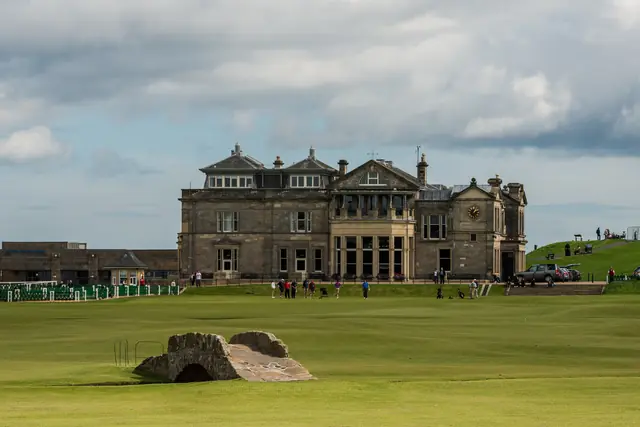
The Swilcan Bridge is also associated with farewells. The organiser's guide recalls Jack Nicklaus' last Open round in 2005 and Arnold Palmer's final appearance in 1995. These moments explain some of the attention around the bridge, though a championship spectator must follow the permitted routes and should not expect access for a personal photograph during play.
Cameron Smith won the 150th Open at St Andrews in 2022. The next champion there will be decided in 2027, so avoid treating a familiar player's past record as a prediction. The history adds context to the visit; the attraction of attending is that a fresh story will unfold.
Build history into a practical St Andrews break
Set aside time for The R&A World Golf Museum and town sights on a day when you are not trying to follow every shot. Museum admission is separate from championship entry. Check its date-selected tickets directly and leave time to walk through town afterwards. A quieter visit can help make sense of the names you hear repeatedly beside the ropes.
If taking a history-minded companion who does not want a whole week of golf, combine one session with a town day and a coast walk. Our St Andrews accommodation guide explains the base options, and the week itinerary helps divide the trip. Choose a room that makes the evening and the next morning straightforward as well as putting you near the famous finishing holes.
The rota grows beyond its first homes
Three Scottish locations defined the early travelling championship: Prestwick, St Andrews and Musselburgh. Their differences matter. The first Opens were staged entirely at Prestwick, but the later rotation made the host part of the contest’s identity. The archive records Tom Kidd at St Andrews in 1873 and Mungo Park at Musselburgh in 1874. A championship shared between places could acquire more than one local tradition.
Muirfield entered the story in 1892, when Harold Hilton won. Two years later Royal St George’s became the first host outside Scotland, with J.H. Taylor the champion. These additions widened both the geography and the test. Links golf remained the common thread, yet the championship was no longer confined to the same early circuit. The organiser’s venue history traces that expansion.
Royal Portrush supplied another important change in 1951: The Open went outside Scotland and England, and Max Faulkner won. Its later returns show why a rota should be understood through actual host years rather than a permanent sequence. A course can remain central to championship memory through a long interval between editions. The complete champions table ties each result to its venue; the future venues guide separates those historical appearances from announced travel plans.
The amateur medal within an open championship
The Silver Medal has recognised the leading amateur who completes all 72 holes since 1949. That finishing requirement is important: being the best-placed amateur when the cut falls does not by itself secure the award. Amateur status and a completed championship are both part of the distinction. The medal therefore rewards a separate achievement within the same competition, rather than dividing the Open into two unrelated tournaments.
Frank Stranahan won four of the first five Silver Medals, including the 1951 championship at Royal Portrush. He had also finished tied second overall in 1947, before the medal existed. Those results demonstrate the competitive significance of amateur golf in this history. The official Silver Medal list distinguishes the award’s own starting point from earlier leading-amateur performances.
For a spectator, the amateur contest offers another reason to follow a player away from the leading professional groups. A result well down the overall leaderboard may settle a meaningful honour. Read the Amateur Championship history alongside this account to understand the different competition from which some Open amateurs emerge. Its match-play title and the Open’s stroke-play medal tell related stories, but they are separate achievements.
The original jug and the trophy in the ceremony
The move from the original Claret Jug to the trophy used in later presentations has a specific date sequence. The decision to retain the original followed the 1927 championship; Walter Hagen received the replica after winning in 1928. The organiser’s account of the championship identifies Hagen’s earlier presentations in 1922 and 1924, when the original was still awarded. Knowing that sequence helps make sense of photographs of the same champion holding the trophy in different years.
There is no need to treat a replica as a lesser sporting prize. The championship’s continuity lies in the competition, its champions and the ceremony as well as the surviving object. When reading a museum caption, however, the distinction between original and presentation trophy is worth keeping. It explains how the championship can preserve a historic piece while continuing the familiar celebration for each new winner.
Explore more golf history
Explore the History section and follow the golf history timeline.
Find accommodation for your visit
Some links earn us a small commission at no extra cost to you. Affiliate disclosure.
Sources and useful official links
- Confirmed source: The Open: official championship
- Confirmed source: The Open: the 1860s
- Confirmed source: The Open: the Claret Jug
- Confirmed source: The R&A: Tom Kidd and the Claret Jug
- Confirmed source: The Open: championship history
- Confirmed source: The R&A: St Andrews Open history and champion profiles
- Confirmed source: The R&A: Old Course features and historic moments
- Confirmed: Open venue development
- Confirmed: Silver Medal winners and completion condition
- Confirmed: original and replica Claret Jugs
Useful reading for your visit
You might also like

The Open 2027 St Andrews: Tickets & Hotels
Find a practical base and prepare for championship golf at St Andrews.

Ryder Cup 2027: Tickets, Dates & Hotels
Build a Ryder Cup break around Limerick, Adare and your ticketed days.

First Time at a Golf Tournament: A Visitor Guide
For your first golf tournament, choose a day that suits your interests, book admission through the organiser and plan a manageable route with breaks. Comfortable shoes, weather protection and a reliable return journey matter more than knowing every golf rule.
Visit today
- St Andrews Old Course visitor guide
- The Open 2027 at St Andrews
- Where to stay for The Open 2027 at St Andrews
Some links earn us a small commission at no extra cost to you. Affiliate disclosure.