

The story and its setting
Irish golf’s modern golden era is best understood as a sequence of different achievements, rather than the story of one player handing a trophy to the next. Padraig Harrington established himself as a multiple major champion. Graeme McDowell won a US Open whose final round rewarded patience. Darren Clarke finally lifted the Claret Jug at Sandwich. Rory McIlroy brought a succession of major victories and, eventually, a career Grand Slam. Shane Lowry won an Open in Ireland. Together, their careers connect the island’s golf with championship venues across Britain, Ireland and the wider world.
“Golden era” is a description, not an official category with an agreed opening and closing date. This guide concentrates on the major victories and the British and Irish courses where visitors can understand them. It does not rank the five careers or treat every successful season as the same kind of accomplishment. The Open champions list, the Irish Open history and the Ryder Cup results provide the underlying records.
Padraig Harrington: two Opens and a PGA
Harrington won the 2007 Open at Carnoustie after a play-off with Sergio Garcia. The setting is important to the achievement. Carnoustie’s closing holes, and particularly the Barry Burn, make the finish something a visitor can follow through the course rather than only through a final score. His victory did not come from an uninterrupted march down the last fairway. It survived a difficult conclusion and then required another contest. The championship’s official 2007 archive records the result and the sequence.
A year later he retained the title at Royal Birkdale. Back-to-back victories at different Open venues are a useful antidote to the idea that a champion has mastered one particular course and simply repeated the performance. Carnoustie and Birkdale sit in different landscapes, and each championship has its own conditions and competitive story. Harrington’s two titles link an Angus visit with the Lancashire coast without making those courses interchangeable. See the Carnoustie history and Birkdale history for the wider championship context.
Harrington added the 2008 PGA Championship at Oakland Hills. That third major came in the same season as his second Open, giving the period a significance that a Claret Jug tally alone would miss. The PGA Championship’s official player record confirms the Oakland Hills win. A British golf trip cannot reproduce the American venue, but it can follow the two Open victories that belong to the same concentrated run of success. His subsequent career should not be used to blur the difference between those men’s majors and later senior championships.
Graeme McDowell: the breakthrough at Pebble Beach
McDowell won the 2010 US Open at Pebble Beach with an even-par total of 284, one stroke ahead of Gregory Havret. The USGA’s championship results establish the score and margin. Its contemporary account notes that he became the first European winner of the championship in forty years. That was a specific US Open milestone, rather than a claim that European golfers had gone forty years without winning any major.
His final-round 73 also gives the victory its own character. A winning Sunday need not be the lowest round of a championship or a parade of birdies. The task changes with the course, the conditions and what the other contenders do. The USGA’s retrospective records the pressure surrounding that closing round. It is possible to recognise the achievement without supplying unrecorded thoughts, invented conversations or a quotation reconstructed from memory.
There was a British connection before the American victory. McDowell had won the Celtic Manor Wales Open that season. The USGA’s later account of his championship year identifies that preparation, connecting the Pebble Beach result with a course that also hosted the Ryder Cup in 2010. For readers planning a golf-history visit, the Welsh championship courses history explains why Celtic Manor belongs in this story. It would be misleading to describe a Welsh stop as the site of his US Open triumph, but equally limiting to treat the American major as having no connection with the British season.
Darren Clarke: an Open at Sandwich
Clarke’s 2011 Open victory belongs to Royal St George’s. The championship archive records a winning total of 275, with Dustin Johnson and Phil Mickelson sharing second place three strokes behind. This was an Irish champion winning on the Kent coast, not a home championship staged in Ireland. The distinction matters when tracing the subsequent significance of Lowry’s victory at Portrush. Both belong to Irish golf’s modern history, but the setting and public experience were different.
Royal St George’s also places Clarke within a much longer championship narrative. It was the first English course to host The Open, in 1894, and its winners include figures from very different generations. A visitor standing beside its links is therefore looking at more than the scene of one celebrated weekend. The course history lets Clarke’s achievement sit alongside that earlier record. For the precise 2011 result, use The Open’s official edition page.
The final round also explains why the margin alone is not the whole story. Mickelson briefly caught Clarke, but Clarke made an eagle at the seventh and steadied his championship with nine consecutive pars. Johnson drew within two strokes before going out of bounds at the fourteenth. Those are specific golfing turning points, rather than a general claim that the favourite never faced a challenge. The Open’s report also records Clarke’s winter preparation at Royal Portrush, linking the cool, wet and windy conditions at Sandwich with golf he had played back in Northern Ireland.
Rory McIlroy: from Congressional to the Grand Slam
McIlroy won the 2011 US Open at Congressional by eight strokes. The result came the year after McDowell’s victory, giving the championship consecutive winners from Northern Ireland. McIlroy’s winning total was 268, sixteen under par. The official USGA record supports those numbers. His performance and McDowell’s should not be collapsed into one formula: their winning totals and margins describe markedly different championships.
For a trip focused on Britain and Ireland, McIlroy’s 2014 Open at Royal Liverpool is the central major venue. He won at Hoylake before adding that season’s PGA Championship. The official Open archive gives the British part of the story its exact setting. It also explains why Royal Liverpool belongs in an itinerary following this generation, even though the course is across the Irish Sea. The major careers were international; a meaningful route follows the championships rather than assuming that every important location must be in a player’s home country.
McIlroy completed the career Grand Slam by winning the 2025 Masters, defeating Justin Rose in a play-off. The PGA of America’s account and the PGA Tour’s final report document the achievement. A career Grand Slam means winning each of the four men’s majors during a career; it does not mean winning all four in one calendar year. That distinction is particularly helpful when reading the separate story of Bobby Jones in 1930, when the recognised championship set was different.
Shane Lowry: an Open in Ireland
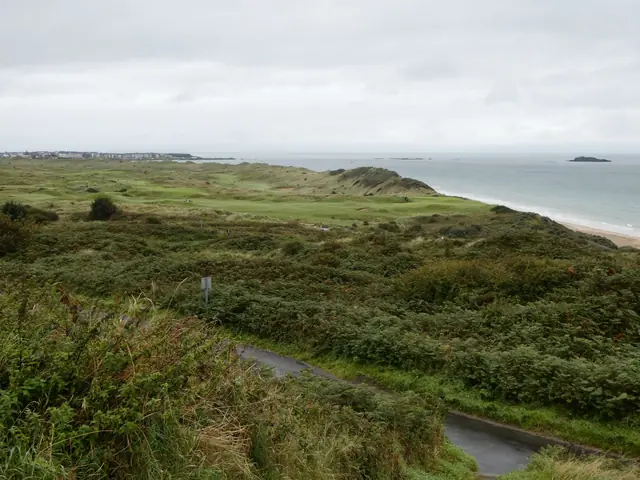
Lowry’s 2019 victory at Royal Portrush combined an individual major breakthrough with an important venue return. The Open had not been staged there since 1951. Its return brought the championship to Northern Ireland, and Lowry won by six strokes. The official edition archive is the place to check the result. The wider meaning comes from putting the two dates together: a long absence ended with an Irish winner.
His earlier Irish Open victory was also unusual: he won the 2009 championship as an amateur. That is a professional tournament won by an amateur entrant, a different category from winning an amateur championship. The distinction makes his route into the professional game more interesting, not less. The Irish Open’s history gives that performance its own place, while the Portrush result belongs to the record of men’s majors.
Following these five careers creates several possible journeys rather than one compulsory tour. Carnoustie and Birkdale tell Harrington’s Open story; Sandwich adds Clarke; Hoylake adds McIlroy; Portrush adds Lowry and the wider Northern Irish connection. Celtic Manor introduces McDowell’s 2010 season. Choose a small number of places and read their histories before travelling. The relevant venue guides cover access and the current event hubs cover tickets; a past championship does not by itself establish that a visitor can enter a private club or walk a live course today.
Sources and useful official links
- Confirmed: official 2007 archive
- Confirmed: PGA Championship’s official player record
- Confirmed: official USGA record
- Confirmed: USGA’s retrospective
- Confirmed: The Open’s official edition page
- Confirmed: official Open archive
- Confirmed: PGA of America’s account
- Confirmed: PGA Tour’s final report
- Confirmed: official edition archive
- Confirmed: Official and historical background
- Confirmed: Official and historical background
- Confirmed: Official and historical background
- Confirmed: Official and historical background
- Confirmed: Official and historical background
- Confirmed: Official and historical background
- Confirmed: Official and historical background
- Confirmed: Official and historical background
- Confirmed: Official and historical background
Useful reading for your visit
Visit today
Some links earn us a small commission at no extra cost to you. Affiliate disclosure.