

The Open crosses the border
Royal St George's occupies a distinctive place in championship history: in 1894 it became the first course outside Scotland to host The Open. The club had been founded in 1887, associated with Dr William Laidlaw Purves's wish to establish a southern English links comparable with the Scottish courses he knew. The R&A's account links his choice of ground with the view from St Clement's church tower in Sandwich. It is best presented as that published historical account, rather than embellished into an invented conversation.
The first English Open also involved the practical problem of bringing Scottish professionals south. The R&A records negotiated rail fares and a record field. Travel was already part of championship planning: the new venue changed the journey as well as the golf. For today's visitor, Sandwich's significance begins with that expansion of the competition, not only with the winners seen in recent television coverage. The R&A: the first English Open.
A course with changing questions
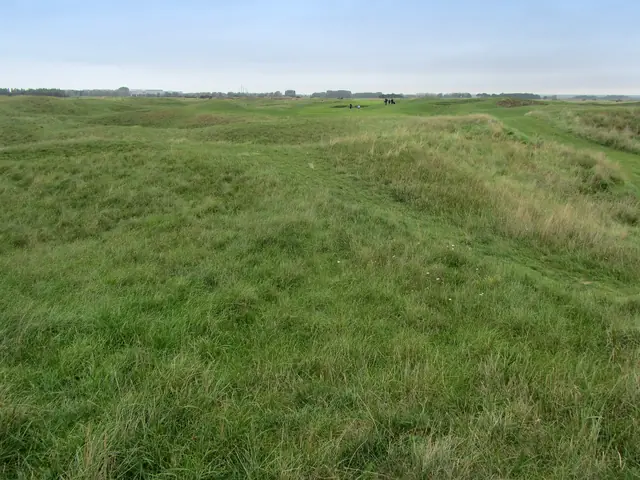
St George's is not a simple flat strip beside the sea. Its ground and lines of play ask players to judge the next position, while hazards near the closing holes have repeatedly influenced championships. The club's course guide shows a sequence that includes long par fours, short holes and par fives, rather than a test based on one repeated kind of shot.
Course changes mean that a historical hole description must be read against its own championship. The physical landscape has continuity, but tees, bunkering and championship preparation have developed. A current yardage should not be inserted into an old story as if nothing had changed. The best way to use the history is to recognise the recurring decisions: where to place the ball, when a recovery is realistic and how much risk a particular position on the leaderboard justifies. Royal St George's: current course guide.
Taylor and Vardon establish the early record
J.H. Taylor won the 1894 championship with 326, five strokes ahead of Douglas Rolland. It remains The Open's highest winning seventy-two-hole total. The figure should not be treated as a simple measure of poor play: it belongs to the conditions, equipment and course preparation of that competition. Taylor became the first English professional champion.
Harry Vardon won in 1899 with 310, five strokes ahead of Jack White, and returned to win in 1911 after tying Arnaud Massy on 303. The later play-off ended before its full scheduled distance when Massy conceded. Those two victories formed part of Vardon's record six Opens. They also connect the course with Jersey, the country used for him in The R&A's current nationality feature. The R&A: 1899; 1911.
1904: scoring moves into a new range
Jack White won in 1904 with 296, becoming the first champion to finish below three hundred over seventy-two holes. His rounds improved throughout the championship, from 80 to 75, 72 and 69. Taylor and James Braid finished one stroke behind. The week also produced new low-round marks as the competitors found different ways to score.
This edition is useful for anyone comparing historical records. White's total was a milestone in its own time; it was not a claim that the course was permanently easier than in 1894. A record belongs to a defined competition and format. The scores can chart the championship's development without pretending that all generations played under identical circumstances. The R&A: White's breakthrough total.
Hagen's two Sandwich titles
Walter Hagen won at St George's in 1922 with 300, one stroke ahead of Jim Barnes and George Duncan. He was the first US-born Open champion, following the St Andrews-born American Jock Hutchison in 1921. Birthplace and represented country are different pieces of information, and keeping them separate makes the championship's international history more accurate.
Hagen won again here in 1928, finishing on 292 to beat Gene Sarazen by two. These victories made St George's a central venue in his four-title Open career. They are also part of the contest's changing professional culture, as players crossed the Atlantic and competed in careers extending beyond one national circuit. The R&A: 1922; 1928.
Cotton's record round and Whitcombe's storm
Henry Cotton won the 1934 Open with 283, five strokes ahead of Sid Brews. His second-round 65 became one of the championship's famous scoring achievements and helped establish a substantial lead. The final day was less comfortable, but the earlier advantage allowed him to complete the title.
Reg Whitcombe won in 1938 with 295, two strokes ahead of Jimmy Adams. The R&A describes a severe storm that damaged the championship's exhibition tent and made scoring exceptionally difficult. The contrast between the two editions is instructive: the same venue produced a record low round and, four years later, a championship remembered for survival in the wind. Neither should be used as a permanent description of how St George's always plays. The R&A: Cotton; Whitcombe.
1949: Locke and Bradshaw play again
Bobby Locke and Harry Bradshaw tied on 283 in 1949. Locke won the thirty-six-hole play-off, collecting the first of his four Opens. Bradshaw's encounter with a ball lying in a broken bottle became a lasting story, but it should not replace the full result. He recovered sufficiently to tie after the scheduled rounds, and the extra contest then determined the champion.
The distinction between a memorable incident and the eventual sporting outcome matters particularly here. A single unusual lie can dominate the retelling, while the many other strokes disappear. The championship record preserves the tie, the format of the play-off and the winner. The story of the bottle adds context rather than changing those facts. The R&A: the 1949 championship.
The long return and two different champions
The Open returned to St George's in 1981 after a thirty-two-year interval. Bill Rogers won with 276, four strokes ahead of Bernhard Langer. He had almost missed his opening tee time after misreading the starting information, a practical mishap that could have ended his week before the championship golf began.
Sandy Lyle won the next edition here in 1985 with 282, one stroke ahead of Payne Stewart. His approach at the last left him in the hollow beside the green, but he eventually completed a bogey and waited for the remaining contenders. A championship need not finish with a birdie to produce a worthy winner. Lyle's earlier scoring had created a total the others still had to beat. The R&A: Rogers; Lyle.
1993: Norman's outstanding final round
Greg Norman won in 1993 with 267, two strokes ahead of Nick Faldo. His final-round 64 set a new low closing round for an Open champion at that time, and the total improved the championship record. All four of his rounds were below seventy. The result gave him a second Claret Jug after Turnberry in 1986.
Faldo's challenge gives the performance its competitive context. The defending champion had made 63 in the second round and remained a serious contender, but Norman's final day supplied the difference. A course history should preserve the strength of the opposition as well as the winner's number: the achievement was made against players who were themselves producing exceptional golf. The R&A: Norman in 1993.
A debut winner and a long-awaited victory
Ben Curtis won the 2003 Open with 283, one stroke clear of Thomas Bjørn and Vijay Singh. It was his first Open appearance. Bjørn's late bunker trouble became prominent in the coverage, but Curtis had already supplied a total that the other contenders failed to better. The winner's composure and necessary finishing strokes belong alongside the better-known collapse.
Darren Clarke won in 2011 with 275, three strokes ahead of Phil Mickelson and Dustin Johnson. His experience of links golf helped him handle the conditions and complete a long-awaited first major. The two editions resist a single formula for success: one rewarded an unfamiliar debutant, the other an established competitor who had played many Opens before collecting the trophy. The R&A: Curtis; Clarke.
2021: Morikawa wins the delayed return
The 2020 Open was cancelled because of the COVID-19 pandemic. When the championship resumed at St George's in 2021, Collin Morikawa won with 265, two strokes ahead of Jordan Spieth. A bogey-free final-round 66 completed a successful debut in The Open. His total became the lowest winning score at this venue.
That result brought the completed St George's host record to fifteen Opens. A visitor can trace them from Taylor's first English championship to Morikawa's modern iron play, with changes in equipment, travel, broadcasting and course preparation along the way. Sandwich's other historic links broaden the trip, but this course's own record is substantial enough to reward time on its own terms. The R&A: the 2021 championship.
One hollow, two different championship endings
The hollow beside the final green links the 1922 and 1985 championships. George Duncan's approach finished there when he needed a four to tie Hagen; he made five and finished one stroke short. Lyle later encountered the same named area while completing his winning total. The place can therefore be associated with both a missed chance and a successful championship.
That is the value of looking at a course through more than one edition. A hazard does not carry a single inevitable outcome. Its effect depends on the player's lie, available recovery, remaining strokes and position against the field. When a visitor recognises Duncan's Hollow from an old account, the useful next step is to consider those circumstances. The name preserves a story, but the wider championship record prevents that story from becoming a misleading rule about what must happen there. The R&A: Duncan's finish and the hollow.
Championships hosted
Championships at Royal St George’s appear below, bringing together the competitions covered in this History section. Qualifying courses are included.
| Year | Championship | Course | Champion or winning team | Source note | Sources |
|---|---|---|---|---|---|
| 1892 | The Amateur | St George’s | John Ball Jr (Royal Liverpool) | Official championship result | Official · Cross-check |
| 1894 | The Open — 34 | Royal St George’s | J.H. Taylor | Official championship result | Official · Cross-check |
| 1896 | The Amateur | St George’s | Freddie Tait (Black Watch) | Official championship result | Official · Cross-check |
| 1899 | The Open — 39 | Royal St George’s | Harry Vardon | Official championship result | Official · Cross-check |
| 1900 | The Amateur | St George’s | Harold Hilton (Royal Liverpool) | Official championship result | Official · Cross-check |
| 1904 | The Amateur | Royal St George’s | Walter Travis (USA) | Official championship result | Official · Cross-check |
| 1904 | The Open — 44 | Royal St George’s | Jack White | Official championship result | Official · Cross-check |
| 1908 | The Amateur | Royal St George’s | E A Lassen (Lytham & St Annes) | Official championship result | Official · Cross-check |
| 1911 | The Open — 51 | Royal St George’s | Harry Vardon | Official championship result | Official · Cross-check |
| 1914 | The Amateur | Royal St George’s | Laurence Jenkins (Troon) | Official championship result | Official · Cross-check |
| 1922 | The Open — 57 | Royal St George’s | Walter Hagen | Official championship result | Official · Cross-check |
| 1928 | The Open — 63 | Royal St George’s | Walter Hagen | Official championship result | Official · Cross-check |
| 1929 | The Amateur | Royal St George’s | Cyril Tolley (Rye) | Official championship result | Official · Cross-check |
| 1930 | Walker Cup | Royal St. George's G.C., Sandwich, England | USA | Official championship result | Official · Cross-check |
| 1934 | The Open — 69 | Royal St George’s | Henry Cotton | Official championship result | Official · Cross-check |
| 1937 | The Amateur | Royal St George’s | Robert Sweeny Jr (Royal & Ancient) | Official championship result | Official · Cross-check |
| 1938 | The Open — 73 | Royal St George’s | Reg Whitcombe | Official championship result | Official · Cross-check |
| 1948 | The Amateur | Royal St George’s | Frank Stranahan (USA) | Official championship result | Official · Cross-check |
| 1949 | The Open — 78 | Royal St George’s | Bobby Locke | Official championship result | Official · Cross-check |
| 1959 | The Amateur | Royal St George’s | Deane Beman (USA) | Official championship result | Official · Cross-check |
| 1967 | British Masters | Royal St George's | Tony Jacklin | Reported in part | Official · Cross-check |
| 1967 | Walker Cup | Royal St. George’s G.C., Sandwich, England | USA | Official championship result | Official · Cross-check |
| 1972 | The Amateur | Royal St George’s | T W B Homer (Walsall) | Official championship result | Official · Cross-check |
| 1975 | PGA Championship | Royal St George’s GC, Sandwich, Kent, England | Arnold Palmer | Official championship result | Official · Cross-check |
| 1976 | PGA Championship | Royal St George’s GC, Sandwich, Kent, England | Neil Coles | Official championship result | Official · Cross-check |
| 1977 | PGA Championship | Royal St George’s GC, Sandwich, Kent, England | Manuel Piñero | Official championship result | Official · Cross-check |
| 1980 | PGA Championship | Royal St George’s GC, Sandwich, Kent, England | Sir Nick Faldo | Official championship result | Official · Cross-check |
| 1981 | The Open — 110 | Royal St George’s | Bill Rogers | Official championship result | Official · Cross-check |
| 1983 | PGA Championship | Royal St George’s GC, Sandwich, Kent, England | Seve Ballesteros | Official championship result | Official · Cross-check |
| 1985 | The Open — 114 | Royal St George’s | Sandy Lyle | Official championship result | Official · Cross-check |
| 1988 | Curtis Cup | Royal St George’s, England | GB&I | Official championship result | Official · Cross-check |
| 1993 | The Open — 122 | Royal St George’s | Greg Norman | Official championship result | Official · Cross-check |
| 1997 | The Amateur | Royal St George’s/Royal Cinque Ports | Craig Watson (East Renfrewshire) | Official championship result | Official · Cross-check |
| 2003 | The Open — 132 | Royal St George’s | Ben Curtis | Official championship result | Official · Cross-check |
| 2006 | The Amateur | Royal St George’s/Prince's | Julien Guerrier (France) | Official championship result | Official · Cross-check |
| 2011 | The Open — 140 | Royal St George’s | Darren Clarke | Official championship result | Official · Cross-check |
| 2014 | Women’s Amateur | Royal St George's | Miss E Pedersen | Official championship result | Official · Cross-check |
| 2017 | The Amateur | Royal St George’s/Prince’s | Harry Ellis (Meon Valley) | Official championship result | Official · Cross-check |
| 2021 | The Open — 149 | Royal St George’s | Collin Morikawa | Official championship result | Official · Cross-check |
| 2025 | The Amateur | Royal St. George's and Royal Cinque Ports | Ethan Fang (USA) | Official championship result | Official · Cross-check |
Sources and useful official links
- Confirmed: The R&A: the first English Open
- Confirmed: Royal St George's: current course guide
- Confirmed: The R&A: 1899
- Confirmed: 1911
- Confirmed: The R&A: White's breakthrough total
- Confirmed: The R&A: Duncan's finish and the hollow
- Confirmed: 1928
- Confirmed: The R&A: Cotton
- Confirmed: Whitcombe
- Confirmed: The R&A: the 1949 championship
- Confirmed: The R&A: Rogers
- Confirmed: Lyle
- Confirmed: The R&A: Norman in 1993
- Confirmed: The R&A: Curtis
- Confirmed: Clarke
- Confirmed: The R&A: the 2021 championship
Useful reading for your visit
Visit today
- Royal St George's visitor guide
- The Open 2027 at St Andrews
- Where to stay for the AIG Women’s Open at Sandwich
Some links earn us a small commission at no extra cost to you. Affiliate disclosure.