
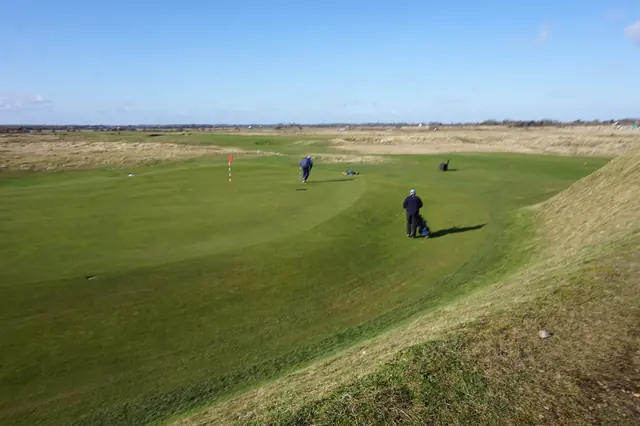

Deal's place in the championship story
Royal Cinque Ports belongs to a remarkable stretch of golfing coastline. Royal St George's is nearby at Sandwich, with Prince's beyond it; all three have staged The Open. Deal's contribution is easy to overlook because its two completed championships were in 1909 and 1920. Yet those dates connect two very different periods: the established British professionals before the First World War, and the championship's return under a new administrative arrangement after it.
For a visitor, the interesting question is how a course with such a short Open list accumulated such a substantial reputation. The answer involves the playing ground itself, the championships that went elsewhere, amateur golf and the continuing route into The Open through qualifying. Treat Deal as a destination with its own story, rather than an optional footnote to Sandwich. The R&A: the three neighbouring championship courses.
From nine holes to a championship ground
The club was established at a meeting in Walmer on 12 February 1892. The original nine holes opened that May; eighteen were available in 1899. Harry Hunter, assisted by his brother Ramsay, was central to the design and construction. The speed of that development matters: Deal entered The Open's venue list only seventeen years after its foundation. It did not need centuries of club tradition before being considered suitable for the championship.
The club's own account also distinguishes royal patronage from the formal grant of its title. The Royal prefix was in use by 1910, while formal permission followed in 1949. Those are separate milestones, so describing 1910 simply as the date of a royal charter would lose a useful piece of the club's history. Royal Cinque Ports: early history.
1909: J.H. Taylor's controlled performance
Taylor won the first Deal Open with rounds of 74, 73, 74 and 74, a total of 295. James Braid and Tom Ball shared second on 301. The sequence makes the character of his victory clear: there was no spectacularly low round masking a disastrous one. His advantage came from sustaining a level of play his nearest challengers could not match across the whole championship.
The R&A's account describes a player making effective use of his short game around demanding greens. Taylor's second-round 73 included his only six of the week, so even the winning performance had to absorb a mistake. By the end of the third round he led by four; the final margin was six. This was his fourth Open title, ending a gap since his previous victory in 1900. The modest-looking difference between individual rounds had produced a decisive result.
Deal also provided an early example of the championship as a commercial gathering: the 1909 event included an exhibition tent for golfing manufacturers and retailers. That detail links an Edwardian championship with a familiar feature of modern tournament weeks. The R&A: the 1909 championship and scores.
1920: two eighties and a remarkable recovery
George Duncan's victory was almost the reverse of Taylor's. His opening 80 and 80 left him thirteen strokes behind Abe Mitchell at halfway. Duncan then returned 71 and 72 to finish on 303, two ahead of Sandy Herd. Mitchell's third-round 84 was central to the reversal; he eventually finished fourth on 307. The leaderboard records both a recovery and a collapse.
The arithmetic is striking. Duncan's first two rounds totalled 160 and his final two 143: seventeen fewer strokes over the second half of the championship. It is a warning against imagining that an eventual winner must have looked in command throughout. At Deal, the champion had appeared very far from that position.
The 1920 Open was also the first after the war and the first under the R&A's permanent administration. A change in the organisation of the championship therefore coincided with one of its most extraordinary changes of fortune. Those two stories give Deal's second Open an importance beyond its winning score. The R&A: the 1920 championship.
Hagen's car and the status of professionals
Walter Hagen's first Open visit brought an incident remembered more readily than his golf that week. Told that the clubhouse was reserved for amateurs, he used his car outside it to change his shoes. The R&A records the episode alongside Duncan's victory. Hagen finished tied 53rd, well away from the contest for the title, but his response exposed the difference in how professionals and amateurs were treated.
The distinction helps a modern visitor understand the period. Playing for a living did not automatically bring the privileges enjoyed by amateur club members. The story should not be presented as a colourful motoring anecdote alone: the location of the car, outside the building he could not use on equal terms, is the point. Deal preserves an episode in the social history of tournament golf as well as two names on the Claret Jug. The R&A: Hagen at Deal.
The Opens that the sea prevented
Two later championships were transferred from Deal to Royal St George's: 1938 and 1949. Flooding prevented Royal Cinque Ports from staging either. The parallel is unusually sharp because Henry Cotton was the defending champion on both occasions. Instead, Reg Whitcombe won the 1938 championship at Sandwich, and Bobby Locke won there in 1949.
These were changes of venue, so their winners belong in the Royal St George's host record. They should not be counted as Deal champions. The distinction also separates flooding from the wartime cancellations: no championship was played in the years affected by war. A planned event, a relocated event and a completed event each describe something different.
The coast is fundamental to this history. It gives links golf its character but has also interrupted the plans made for it. Deal's absence from the subsequent Open rota cannot be read simply as a verdict on the quality of its holes. The R&A: flooding and the lost Opens.
A continuing championship role
Royal Cinque Ports has staged The Amateur Championship in 1923, 1982 and 2013. Its record also includes the 2021 Boys' Amateur, won by Jack Bigham. These are separate competitions, with their own participants and honours, and are part of the explanation for the club's continuing championship standing after 1920.
Final Qualifying creates another connection with The Open. Competitors come to Deal to earn a place in the championship elsewhere; the course becomes a decisive stage in their journey even when it is not the final venue. That role provides a different kind of spectator experience from a major championship, with the qualification outcome itself carrying the drama. The R&A's current venue page records both Deal's older history and its qualifying function, allowing the two to be understood together. The R&A: Royal Cinque Ports and Final Qualifying.
The Halford Hewitt and the team game
The Halford Hewitt introduces a different rhythm. Its teams represent former pupils of participating schools and play foursomes, with partners sharing a ball and taking alternate shots. The competition's official history traces its conception to discussions in 1923 and explains why foursomes suited the founders: it was familiar to amateur golfers and allowed play to fit into a weekend.
That format changes the meaning of an error. A difficult lie or missed putt leaves a partner with the next task, and decisions have to work for a pair rather than one player. It gives a historic links another competitive personality beside individual stroke play. The event's heritage account also acknowledges uncertainty about the precise conversation that produced it, a useful reminder to distinguish a remembered origin story from an uncontested result. The Halford Hewitt: the competition's origins.
The organiser describes Deal as the competition's spiritual home. Royal St George's joined the hosting arrangement in 1950 as the event grew, while Prince's provides further associated competition. The three neighbouring courses therefore have a shared working relationship as well as their individual Open histories. The Halford Hewitt: its courses.
Reading the test on the ground
The modern course card shows variety within the traditional out-and-back setting. There are short holes at the fourth, eighth and fourteenth, while the fifth is listed at 600 yards from the championship tees. Those measurements describe particular tees, rather than a fixed distance that every visitor must play. Looking at the available tees before a round gives a fairer impression than judging the course from its longest card alone.
The closing sequence brings a par four at the fifteenth, a par five at sixteen, and two further par fours. Historical praise for the finish is best tested by watching or playing how those holes ask different questions. The order matters as much as any isolated yardage: a promising position must survive the remaining approaches and greens. Royal Cinque Ports: current course overview.
2027: a return for the Women's Amateur
The R&A has confirmed Royal Cinque Ports for the 124th Women's Amateur Championship, with its current championship page giving 21–26 June 2027. The venue announcement identifies it as the third staging at Deal, following 1902 and 1988. That makes the return a link across 125 years of women's championship golf at the club, not the arrival of an entirely new competition.
The February 2026 announcement originally left the dates unconfirmed; the later championship page now supplies them. This is why a historical guide and a practical travel plan need different kinds of checking. The earlier editions establish the continuity, while the current organiser's information establishes the dates for a prospective visit. Entry arrangements, spectator information and any access restrictions should be checked separately as the event approaches. The R&A: venue announcement; The R&A: confirmed 2027 dates.
Championships hosted
Championships at Royal Cinque Ports appear below, bringing together the competitions covered in this History section. Qualifying courses are included.
| Year | Championship | Course | Champion or winning team | Source note | Sources |
|---|---|---|---|---|---|
| 1902 | Women’s Amateur | Deal | Miss M Hezlet | Official championship result | Official · Cross-check |
| 1909 | The Open — 49 | Royal Cinque Ports | J.H. Taylor | Official championship result | Official · Cross-check |
| 1920 | The Open — 55 | Royal Cinque Ports | George Duncan | Official championship result | Official · Cross-check |
| 1923 | The Amateur | Royal Cinque Ports | Roger Wethered (Worplesdon) | Official championship result | Official · Cross-check |
| 1982 | The Amateur | Royal Cinque Ports | Martin S Thompson (Middlesbrough) | Official championship result | Official · Cross-check |
| 1988 | Women’s Amateur | Royal Cinque Ports | Miss J Furby | Official championship result | Official · Cross-check |
| 1997 | The Amateur | Royal St George’s/Royal Cinque Ports | Craig Watson (East Renfrewshire) | Official championship result | Official · Cross-check |
| 2013 | The Amateur | Royal Cinque Ports/Prince's | Garrick Porteous (Bamburgh Castle) | Official championship result | Official · Cross-check |
| 2025 | The Amateur | Royal St. George's and Royal Cinque Ports | Ethan Fang (USA) | Official championship result | Official · Cross-check |
Sources and useful official links
- Confirmed: The R&A: the three neighbouring championship courses
- Confirmed: Royal Cinque Ports: early history
- Confirmed: The R&A: the 1909 championship and scores
- Confirmed: The R&A: the 1920 championship
- Confirmed: The R&A: Hagen at Deal
- Confirmed: The R&A: flooding and the lost Opens
- Confirmed: The R&A: Royal Cinque Ports and Final Qualifying
- Confirmed: The Halford Hewitt: the competition's origins
- Confirmed: The Halford Hewitt: its courses
- Confirmed: Royal Cinque Ports: current course overview
- Confirmed: The R&A: venue announcement
- Confirmed: The R&A: confirmed 2027 dates
Useful reading for your visit
Visit today
- Royal Cinque Ports visitor guide
- The Open 2027 at St Andrews
- Where to stay for Royal Cinque Ports and Deal
Some links earn us a small commission at no extra cost to you. Affiliate disclosure.