
Stay locally for an uncomplicated day, or use Dundee for a wider city break and plan the return train before choosing your finishing time.
Quick facts
- Competition dates
- Alfred Dunhill Links Championship 2027: 30 September–3 October 2027
- Venue
- Carnoustie Golf Links
- Full postal address
- Links House, Links Parade, Carnoustie, Angus, DD7 7JE, United Kingdom Source
- Rail connection
- Carnoustie Source
- Locality
- Carnoustie, Angus
- Tickets
- Alfred Dunhill Links Championship 2027: 2027 register interest in DP World Tour calendar; 2026 first three days free all three courses, Sunday Old Course advance ticket only
Why Carnoustie deserves its own day
Confirmed: Carnoustie Golf Links operates the Championship, Burnside and Buddon courses. The Championship Course is the famous tournament stage and one of the three Alfred Dunhill Links Championship venues. When looking at a playing package, a restaurant reservation or accommodation description, establish which course it concerns. The word “Carnoustie” alone does not identify a round on the Championship Course, and an event spread across Fife and Angus requires more than one local journey.
The venue's own history records golf here in 1560. Its championship story is long, but the appeal for a spectator is immediate: this is a place where a ball's position can make the next shot look remarkably uncomfortable. You do not have to arrive knowing the archive. Watch how players respond after a poor lie or a change in the wind and the course starts explaining itself.
Our suggestion: give Carnoustie a whole day rather than treating it as an interchangeable extra on a St Andrews itinerary. During the Dunhill, pick the course you want to see and the players scheduled there. Outside a tournament, book whatever visit or playing activity you actually want before making the journey. Leave time for the seafront and a proper meal. Rushing away immediately after the golf misses the benefit of choosing a town-based coastal venue in the first place.
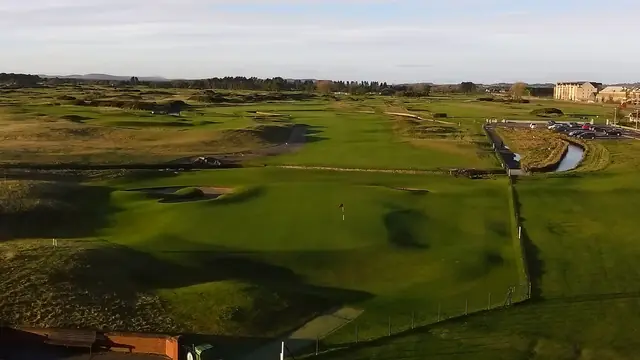
A view of the course

Famous holes and the nature of the test
Confirmed: the club's hole guide calls the sixth Hogan's Alley, commemorating Ben Hogan's 1953 Open victory. It describes a driving line between bunkers and out of bounds, with further trouble affecting the next shot. That is a useful introduction to Carnoustie's character: the demanding option may also offer the best position, and a cautious drive does not necessarily make everything afterwards straightforward.
The official guide also identifies Jockie's Burn at the third and describes the fourth as a double green. Use these details to understand the layout without reducing it to one notorious finish. The opening stretch gives you plenty to watch, from positioning off the tee to the way players judge an approach across trouble. A ball that finds the green can still leave a difficult putt if it finishes in the wrong part.
Our suggestion: spend time watching approach shots and recoveries rather than moving after every drive. The distinction between “on the fairway” and “in a useful position” is especially revealing here. Take the official course plan with you and compare the competitors' choices. Avoid quoting a fixed yardage to explain every hole; tournament settings vary and the wind may change a shot more than the length printed on a scorecard. A few minutes observing where several players aim can be more instructive than following one group in silence for an hour.
Our suggestion: for a multi-course Dunhill visit, do not describe your luggage destination simply as “the golf hotel”. Label the actual accommodation and keep the Carnoustie day distinct from St Andrews and Kingsbarns. The towns are separate journeys, and an early-round draw may put the player you want on a different course. Check the allocation before deciding which day to reserve locally, and leave time to return for dinner without a hurried transfer.
Finding a useful spectator position
Our suggestion: divide your viewing into an early exploratory walk and a later settled session. First learn the permitted paths and crossings, identify toilets and food points, and see how long it actually takes your group to move. Then choose a position where you can watch successive players without repeatedly packing and unpacking. Carnoustie's reputation can encourage spectators to head straight for the final holes; a quieter place earlier in the round can offer a much better view of technique.
The closing stretch is worth considering when it is accessible, but approach it as a popular destination. A golf course flyover does not show championship ropes, temporary structures, queues or restricted routes. Use the current organiser's map before deciding that you can move quickly from one hole to another. Future event gate times, grandstand arrangements, mobility provision and traffic management should be taken from the relevant event rather than from an earlier visit.
For a less mobile companion, work backwards from an appropriate viewing area and a realistic route from the entrance. Ask about the ground surface and the location of accessible toilets, not only whether a platform exists. Keep a meeting point that is recognisable without a phone signal. If your group splits, agree the time for leaving as well as the place; the final train matters even if somebody has become absorbed in a dramatic finish.
Rail, road and arrival planning
Confirmed: Carnoustie has a National Rail station and ScotRail provides journey planning and current service information. Search your precise travel date, including the Sunday pattern when relevant. A station in the town is a useful advantage, but you still need to identify the event entrance and the walk from your arrival platform. Do not assume a route you used for a normal clubhouse visit remains open during a championship.
Our suggestion: a Dundee base and train can be a sensible combination for visitors who prefer to avoid event parking. Compare outward and return services together before booking the room. Give yourself enough margin to leave the course, walk to the station and board without running. Travelling with children or someone who tires quickly calls for a larger margin, not an optimistic timetable that only works if every crossing is clear.
By road, navigate to the official spectator car park once its instructions are available. A golf-club postcode can send you towards the wrong entrance or a restricted road. For a playing visit, follow the club's instructions and allow time for reception, changing and equipment. If arriving through Edinburgh or another airport, compare the complete transfer rather than simply the flight fare. A hired car may suit a broader Angus holiday, while a rail journey can remove the problem of parking at a busy event. Neither choice excuses leaving the final leg unresolved.
Which base suits your trip?
Our suggestion: choose Carnoustie itself when the golf is the main purpose and you want a short journey back afterwards. Ask the property for the realistic walk to the tournament entrance and whether breakfast works with your departure. A central room can be more valuable than an extra facility you will never use. If you are bringing a car, establish parking rights and any event-period restrictions directly with the accommodation.
Dundee makes sense for restaurants, a longer stay and companions who want a day away from the course. It is also a sensible place to compare rail connections. Broughty Ferry and Monifieth can suit visitors seeking a different coastal base, but look carefully at the precise accommodation location and transport options. A property listed under a nearby town may sit well beyond its station or evening food choices. Compare walks at both ends of the journey.
Arbroath is another distinct Angus option, particularly if you want to build a wider coastal visit around the golf. The decision should come down to the shape of your holiday: local simplicity, city flexibility or a quieter coastal stay. Add the cost of taxis and parking before calling a room inexpensive. Families should inspect bed arrangements, kitchen facilities and cancellation conditions. A last-minute change of event attendance can otherwise leave you paying for a room configuration that no longer works for the group.
Eating, evenings and time beside the sea
Confirmed: Carnoustie's Links House includes The Rookery, and the venue publishes information about its dining and golf facilities. Check directly before planning a meal there, especially on an event day when normal arrangements may change. A clubhouse location does not automatically put every facility inside your spectator admission, nor does admission guarantee a restaurant table. Keep dining and tournament access as separate booking questions.
Our suggestion: use a local evening to recover rather than adding a long excursion after a full walking day. Carnoustie gives you the option of staying near the golf and looking for dinner in town. Dundee offers a wider city evening if you chose it as your base. Agree which you prefer when booking accommodation. It is frustrating to pay for a peaceful coastal stay and then discover that everyone expected to spend every evening in the city.
On a non-golf morning, leave space for a walk and a slow breakfast instead of filling every hour with another course. Pack dry socks and a layer you can change into before dinner. After rain, being able to leave damp clothes at your accommodation makes an evening much more comfortable. For a group travelling separately, nominate one restaurant meeting point and make clear whether people should eat before or after returning from the course. Do not rely on finding a large table spontaneously at the busiest time.
Booking a round and avoiding small mistakes
Confirmed: Carnoustie Golf Links offers official tee-time booking and publishes information on green fees, caddies, equipment hire and bad-weather policy. Consult those pages when deciding whether to add a round. Check the precise course, date and any player requirements on the booking confirmation. The Burnside or Buddon may form part of a very enjoyable visit, but a package should never be assumed to include the Championship Course unless it says so.
Our suggestion: avoid placing an important playing round immediately before a fixed return journey. Golf, weather and road traffic can all make that unnecessarily tense. If the round is a major purpose of the holiday, keep an overnight stay afterwards and use the evening to enjoy it. Ask how weather cancellations are handled and whether any championship preparation affects visitor times. Hire clubs and caddies should be requested through the venue rather than assumed available on arrival.
For spectators, finish the booking with the ticket day, hotel nights and transport placed side by side. A three-course Dunhill itinerary needs a separate plan for each day, especially if you change base. Carry only what the event allows and keep larger luggage away from the course. Continue with the Dunhill Links hub, compare the Old Course guide and Kingsbarns, then choose the coastal or city base that leaves the least unfinished travel.
History
Watching an event here
Carnoustie visitor guide — championship planning: tickets · hospitality and upgrades.
Watching the Dunhill at Carnoustie
2026 edition, for guidance: walk from Carnoustie station towards Links Parade; the organiser describes the station-to-course walk as about ten minutes. Free event parking follows yellow AA signs, and Blue Badge holders use the Red Car Park. Confirmed: Dunhill visitor information.
The 2026 course guide showed the Thursday 1 October public bus from St Andrews at 09:00 and the return from Carnoustie at 17:00. Use these as 2026 guidance while awaiting 2027 event transport. Official 2026 course map and bus details.
Find accommodation for your visit
Some links earn us a small commission at no extra cost to you. Affiliate disclosure.
Course, rail and accommodation bases
- Course: Carnoustie visitor guide
- Rail connection: Carnoustie railway station
- Stay base: Carnoustie, Scotland
- Stay base: Dundee, Scotland
- Stay base: Arbroath, Scotland
- Stay base: Monifieth, Scotland
- Stay base: Broughty Ferry, Scotland
Map data © OpenStreetMap contributors. Rail connections may differ from the organiser’s event-day station; check the current travel plan. Numbered markers may be offset slightly, with a line showing their map position, to keep the key readable.