
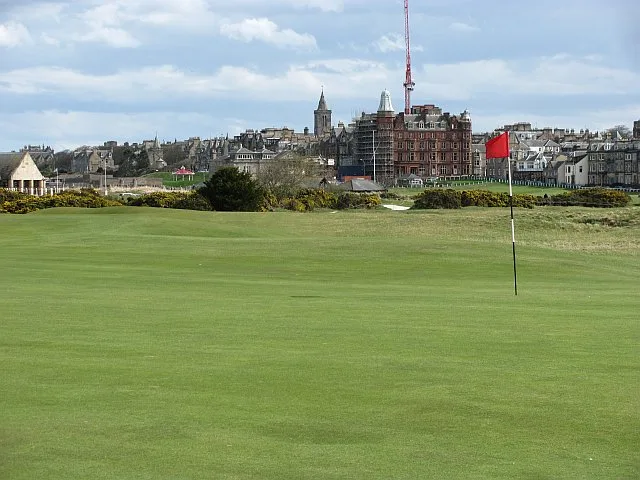

The story behind the championship
The Alfred Dunhill Links Championship began in 2001, combining an individual professional tournament with a professional-amateur team competition across St Andrews, Carnoustie and Kingsbarns. Its predecessor, the Alfred Dunhill Cup, had brought international teams to the Old Course from 1985, giving the modern event a longer St Andrews connection than its own starting date suggests.
The Dunhill Cup before the Links Championship
The Alfred Dunhill Cup began in 1985 as an international professional team event at St Andrews. Australia won the first edition and defended the title in 1986. The competition established a regular autumn connection between the Dunhill name, international golf and the Old Course.
The format placed national teams at the centre of the competition. It brought a different atmosphere from an individual stroke-play championship: players represented a country, individual matches contributed to a team result and a final decided the title.
That distinction matters when reading the later history. The Dunhill Cup and the Alfred Dunhill Links Championship are related through place, sponsorship and tradition, but their champions belong in separate lists. A country's victory in the Cup is a different achievement from a professional winning the individual Links Championship or a pair taking its pro-am team title.
International golf on the Old Course
England and Ireland each won the Cup twice. Sweden won in 1991 and Scotland in 1995. The United States became the first three-time winner in 1996, following earlier successes in 1989 and 1993. South Africa won in 1997 and retained the title in 1998 with Ernie Els, David Frost and Retief Goosen.
These results made the Cup a regular meeting point for prominent players from different tours. The Old Course supplied a familiar setting, while the team format offered contests that could develop differently from a conventional individual leaderboard.
The European Tour's retrospective remembers Sweden's narrow 1991 final against South Africa and the United States' 1993 victory over England. Such matches help explain the Cup's appeal: a national contest could reach its decision through the score of one player on one round, even within the broader team result.
Spain won in 1999, with a team including Sergio García, José María Olazábal and Miguel Ángel Jiménez. The event continued through 2000 before the new Links Championship began the following year. The change retained St Andrews at the heart of the occasion while introducing a different sporting structure.
A new competition in 2001
Paul Lawrie won the inaugural Alfred Dunhill Links Championship in 2001. The Scottish champion finished at eighteen under par, one stroke ahead of Ernie Els. The new event immediately linked a home winner with the three-course format that remains central to its identity.
St Andrews, Carnoustie and Kingsbarns each contributed to the competition. The professional-amateur pairing added another layer: the same week contained an individual professional contest and a team championship. Spectators could follow the main leaderboard while also watching partnerships whose ambitions extended beyond the professional's own score.
For a travel website, this structure is unusually important. The tournament is not confined to one course and one town. Its history encourages a visitor to understand the three venues as a connected golfing landscape, with the final result emerging from performances across different settings.
The event also brought the newer Kingsbarns course into a championship relationship with two long-established Open venues. That combination gives the competition a particular character: it joins different generations of Scottish links golf within one week.
Harrington, Westwood and the early champions
Pádraig Harrington won in 2002 and again in 2006. His first victory came through a play-off with Eduardo Romero; his second was by five strokes. The two results demonstrate different ways of winning the same event, from an extra-hole decision to a substantial final margin.
Lee Westwood won in 2003, followed by Stephen Gallacher in 2004 and Colin Montgomerie in 2005. Gallacher defeated Graeme McDowell in a play-off. Montgomerie's winning total of nine under par contrasts with the much lower totals recorded in some other years, showing how much conditions can shape a links tournament.
Nick Dougherty won in 2007, Robert Karlsson in 2008 and Simon Dyson in 2009. Karlsson's title was also decided by a play-off, with Martin Kaymer and Ross Fisher sharing the regulation total. The early decade therefore offered both decisive winning margins and close finishes settled after the scheduled rounds.
Reading these years together gives the tournament more depth than the celebrity aspect alone might suggest. The pro-am partnerships form part of the occasion, but the professional championship has consistently produced serious competitive golf and a substantial roll of respected winners.
Kaymer, Hoey, Grace and Howell
Martin Kaymer won in 2010 and Michael Hoey followed in 2011. Branden Grace won the 2012 edition, having opened with a sixty at Kingsbarns. David Howell won in 2013 after a play-off against Peter Uihlein.
The three-course format makes those results particularly interesting. A player can produce a remarkable round at one venue and still need to maintain the challenge at the others. The tournament rewards the complete week, rather than one memorable score in isolation.
Grace's opening round provides an obvious link with Kingsbarns, while the eventual championship result belongs to the full competition. Howell's win gives another reason to remember the Old Course as a stage for extra-hole drama. Different parts of the tournament's geography supply different memories.
For spectators planning a return visit, those connections can guide the choice of which course to see. A venue associated with a favourite round or champion adds a personal historical thread to the current tournament, while leaving room to discover how that year's field approaches it.
Oliver Wilson's breakthrough
Oliver Wilson won in 2014, one stroke ahead of Rory McIlroy, Richie Ramsay and Tommy Fleetwood. His victory came after many previous tour starts and a period away from the level of success he had earlier achieved.
The organiser's account presents Wilson as an unexpected champion who regained an important place on tour through his St Andrews success. The result belongs among the event's most distinctive stories because the competition gave a player outside the usual leading group the chance to change his career's direction.
That openness is part of the championship's value. A field can contain major champions and leading international names while still producing a winner whose story is different. The professional tournament supplies its own sporting drama alongside the more relaxed encounters between players and amateurs.
Thorbjørn Olesen won the following year, finishing two strokes clear in 2015. His victory continued a run of different champions before Tyrrell Hatton established the most sustained individual record in the event's history.
Hatton's repeated success
Hatton won in 2016 and successfully defended the title in 2017. His first victory came at twenty-three under par; the second at twenty-four under. The consecutive wins gave the tournament a returning champion who had shown that his success could be repeated.
The 2017 edition also brought Ross Fisher's sixty-one on the Old Course. Fisher finished second, three strokes behind Hatton. The distinction between the exceptional round and the championship result is important: the day's most dramatic score did not overturn the leader's complete-week advantage.
Lucas Bjerregaard won in 2018, one stroke ahead of Hatton and Fleetwood. Victor Perez won in 2019, beating Matthew Southgate by a stroke. Those results interrupted Hatton's run while preserving the pattern of close finishes on the Scottish coast.
Hatton returned to win a third title in 2024. His final total matched the twenty-four-under figure of his 2017 victory, and a final-hole birdie secured a one-stroke win over Nicolas Colsaerts. Three victories across separate periods made his name central to the championship's modern history.
The missed year and the return
The 2020 championship was cancelled because of the Covid-19 pandemic. The gap belongs in the table between Perez's 2019 win and Danny Willett's success in 2021. It was an interruption to an annual competition that had otherwise been played since 2001.
Willett won on his birthday in 2021, finishing two strokes clear. Ryan Fox won in 2022, one ahead of Alex Noren and Callum Shinkwin. Fox's victory added another international champion and another closely decided Sunday to the event's history.
The return mattered to the wider setting as well as to the list of winners. A three-course tournament brings together different communities and travel bases. Its absence left a gap in the familiar autumn sequence; its return restored the connected week across St Andrews, Carnoustie and Kingsbarns.
Weather and the shortened championships
Matt Fitzpatrick won the 2023 edition over fifty-four holes after weather disruption. His rounds of sixty-seven, sixty-four and sixty-six produced a total of 197, nineteen under par. He also won the team championship with his mother, Susan.
The two successes illustrate how the event's competitions can overlap without being identical. The professional's individual score and the partnership's team performance are separate results. Winning both makes a particular edition distinctive, but the champions lists still need to show clearly which title each entry represents.
Robert MacIntyre won another shortened edition in 2025 after high winds associated with Storm Amy disrupted play. His three rounds of sixty-six gave him an eighteen-under-par total of 198 and a four-stroke victory. He became the first Scottish winner since Montgomerie in 2005.
Both shortened editions need their completed-round information in the results table. Their totals cannot be compared directly with seventy-two-hole winning scores. The weather belongs to the explanation of the result, not as an afterthought detached from the numbers.
Meronk and the latest chapter
Adrian Meronk won the 2026 championship at twenty under par, two strokes ahead of Niklas Nørgaard and Casey Jarvis. His closing sixty-eight completed a total of 268. He also won the team competition with Tom Chaplin.
The result supplied another example of a professional succeeding in both contests during the same week. It also continued the international character of a championship that began with a Scottish winner but has drawn its champions from a wide range of golfing countries.
Across the full history, the constants are the three venues and the combination of professional and amateur competition. Around them are changing champions, different weather and the particular relationships formed within each pair. That mixture gives the tournament a character distinct from both The Open and the Dunhill Cup that preceded it.
Visit the links today
Begin with the Alfred Dunhill Links hub and the venue guides for St Andrews, Carnoustie and Kingsbarns. The where-to-stay section helps connect the competition with a realistic base.
Our suggestion is to decide early which part of the three-course experience matters most to you. A day at Carnoustie, a visit to Kingsbarns and a final-round atmosphere in St Andrews each offer a different perspective. Build enough room into the itinerary to enjoy the surrounding towns and coast, rather than trying to watch every venue through hurried daily transfers.
Champions and years not held
| Year | Champion | Venue or reason not held | Total | Winning margin | Sources |
|---|---|---|---|---|---|
| 2001 | Paul Lawrie | Old Course, St Andrews; Carnoustie; Kingsbarns | 270 | 1 stroke | Official · Cross-check |
| 2002 | Padraig Harrington | Old Course, St Andrews; Carnoustie; Kingsbarns | 269 | Play-off | Official · Cross-check |
| 2003 | Lee Westwood | Old Course, St Andrews; Carnoustie; Kingsbarns | 267 | 1 stroke | Official · Cross-check |
| 2004 | Stephen Gallacher | Old Course, St Andrews; Carnoustie; Kingsbarns | 269 | Play-off | Official · Cross-check |
| 2005 | Colin Montgomerie | Old Course, St Andrews; Carnoustie; Kingsbarns | 279 | 1 stroke | Official · Cross-check |
| 2006 | Padraig Harrington | Old Course, St Andrews; Carnoustie; Kingsbarns | 271 | 5 strokes | Official · Cross-check |
| 2007 | Nick Dougherty | Old Course, St Andrews; Carnoustie; Kingsbarns | 270 | 2 strokes | Official · Cross-check |
| 2008 | Robert Karlsson | Old Course, St Andrews; Carnoustie; Kingsbarns | 278 | Play-off | Official · Cross-check |
| 2009 | Simon Dyson | Old Course, St Andrews; Carnoustie; Kingsbarns | 268 | 3 strokes | Official · Cross-check |
| 2010 | Martin Kaymer | Old Course, St Andrews; Carnoustie; Kingsbarns | 271 | 3 strokes | Official · Cross-check |
| 2011 | Michael Hoey | Old Course, St Andrews; Carnoustie; Kingsbarns | 266 | 2 strokes | Official · Cross-check |
| 2012 | Branden Grace | Old Course, St Andrews; Carnoustie; Kingsbarns | 266 | 2 strokes | Official · Cross-check |
| 2013 | David Howell | Old Course, St Andrews; Carnoustie; Kingsbarns | 265 | Play-off | Official · Cross-check |
| 2014 | Oliver Wilson | Old Course, St Andrews; Carnoustie; Kingsbarns | 271 | 1 stroke | Official · Cross-check |
| 2015 | Thorbjørn Olesen | Old Course, St Andrews; Carnoustie; Kingsbarns | 270 | 2 strokes | Official · Cross-check |
| 2016 | Tyrrell Hatton | Old Course, St Andrews; Carnoustie; Kingsbarns | 265 | 4 strokes | Official · Cross-check |
| 2017 | Tyrrell Hatton | Old Course, St Andrews; Carnoustie; Kingsbarns | 264 | 3 strokes | Official · Cross-check |
| 2018 | Lucas Bjerregaard | Old Course, St Andrews; Carnoustie; Kingsbarns | 273 | 1 stroke | Official · Cross-check |
| 2019 | Victor Perez | Old Course, St Andrews; Carnoustie; Kingsbarns | 266 | 1 stroke | Official · Cross-check |
| 2020 | Not held | Covid-19 pandemic | — | — | Official · Cross-check |
| 2021 | Danny Willett | Old Course, St Andrews; Carnoustie; Kingsbarns | 270 | 2 strokes | Official · Cross-check |
| 2022 | Ryan Fox | Old Course, St Andrews; Carnoustie; Kingsbarns | 273 | 1 stroke | Official · Cross-check |
| 2023 | Matt Fitzpatrick | Old Course, St Andrews; Carnoustie; Kingsbarns | 197 | 3 strokes | Official · Cross-check |
| 2024 | Tyrrell Hatton | Old Course, St Andrews; Carnoustie; Kingsbarns | 264 | 1 stroke | Official · Cross-check |
| 2025 | Robert Macintyre | Old Course, St Andrews; Carnoustie; Kingsbarns | 198 | 4 strokes | Official · Cross-check |
| 2026 | Adrian Meronk | Old Course, St Andrews; Carnoustie; Kingsbarns | 268 | 2 strokes | Official · Cross-check |
Every Dunhill Cup winner, 1985–2000
| Year | Winning team | Venue | Sources |
|---|---|---|---|
| 1985 | Australia | Old Course, St Andrews | Official · Cross-check |
| 1986 | Australia | Old Course, St Andrews | Official · Cross-check |
| 1987 | England | Old Course, St Andrews | Official · Cross-check |
| 1988 | Ireland | Old Course, St Andrews | Official · Cross-check |
| 1989 | USA | Old Course, St Andrews | Official · Cross-check |
| 1990 | Ireland | Old Course, St Andrews | Official · Cross-check |
| 1991 | Sweden | Old Course, St Andrews | Official · Cross-check |
| 1992 | England | Old Course, St Andrews | Official · Cross-check |
| 1993 | USA | Old Course, St Andrews | Official · Cross-check |
| 1994 | Canada | Old Course, St Andrews | Official · Cross-check |
| 1995 | Scotland | Old Course, St Andrews | Official · Cross-check |
| 1996 | USA | Old Course, St Andrews | Official · Cross-check |
| 1997 | South Africa | Old Course, St Andrews | Official · Cross-check |
| 1998 | South Africa | Old Course, St Andrews | Official · Cross-check |
| 1999 | Spain | Old Course, St Andrews | Official · Cross-check |
| 2000 | Spain | Old Course, St Andrews | Official · Cross-check |
Sources and useful official links
Useful reading for your visit
Visit today
- St Andrews Old Course visitor guide
- Alfred Dunhill Links Championship 2027
- Where to stay for The Open 2027 at St Andrews
Some links earn us a small commission at no extra cost to you. Affiliate disclosure.