
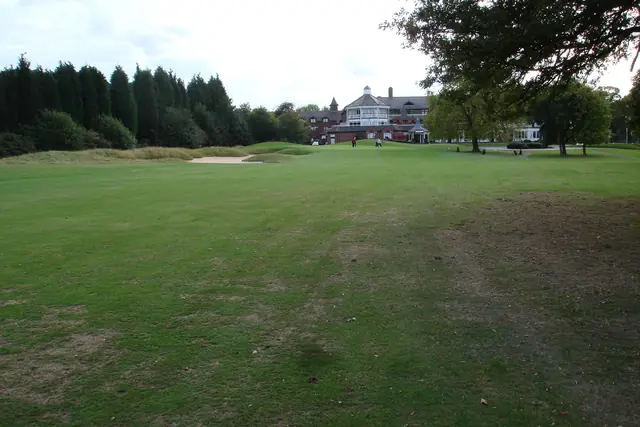

The story and its setting
The Belfry's place in golf history rests on an unusually concentrated run of Ryder Cups. The Brabazon staged the matches in 1985, 1989, 1993 and 2002, turning a relatively young course into a setting recognised far beyond its Midlands home. Each edition contributed something different: a breakthrough European victory, a tied match that retained the trophy, an American away win and a European recovery led by a former winning player.
A modern course becomes a championship stage
The Brabazon was designed by Dave Thomas and Peter Alliss and opened in 1977. Golf Monthly's course history confirms the opening year and records subsequent upgrading and redevelopment. Its comparatively recent foundation is worth remembering. Unlike an Open links whose origins may reach deep into the nineteenth century, this is a course whose international reputation developed rapidly during the television era.
Its architecture provides clear decisions for players and clear scenes for spectators. Water is especially prominent, and two holes have become inseparable from the venue's identity: the short par-four tenth and the water-lined eighteenth. They offer different kinds of tension. At one, a player considers the temptation of reaching the green from the tee; at the other, the approach can arrive with an entire match in the balance. The Ryder Cup did not simply supply memorable names for a noticeboard: it gave those hazards and angles competitive meaning that a visitor can still recognise. Source: the club's design account; independent course history.
1985: the breakthrough
Tony Jacklin's Europe defeated the United States 16½–11½ in 1985. The official Ryder Cup account describes it as the first victory for the home side since Great Britain's win in 1957. That wording matters: the team had become European in the intervening period, so this was both the end of a long losing sequence and the first success under its expanded identity.
Sam Torrance supplied the celebrated winning putt, beating Andy North at the eighteenth. The photograph of his raised arms has become one of the event's most recognisable images. Yet the team context should remain alongside the individual scene. The official retrospective names Seve Ballesteros, Sandy Lyle, Ian Woosnam and Nick Faldo among Jacklin's players. The result was a collective change in the competition's balance, expressed through a single decisive match on the Brabazon's closing hole. Source: official 1985 retrospective; Torrance's winning point.
For someone visiting today, the importance of the eighteenth lies in that relationship between place and consequence. A difficult approach or putt becomes historically distinctive because of what it settled. Read the result before looking at the hole, and it is easier to understand why this particular green keeps appearing in Ryder Cup retrospectives. It was not merely the final hole of an English golf course; for that European team it became the point at which decades of frustration ended.
1989: a draw and a retained trophy
The teams returned in 1989, again with Jacklin captaining Europe. This time the result was 14–14. Europe kept the Ryder Cup as the holder, but did not win the match outright. The difference between winning and retaining is essential to an accurate account: a tied contest can deliver the trophy to the defending side while remaining a draw in the historical results.
Christy O'Connor Jnr's approach at the eighteenth supplied the edition's defining Belfry image. The official account identifies the club as a two-iron and records his one-up singles victory over Fred Couples. The shot's fame should not obscure the match result around it. It helped Europe retain the trophy in a contest that finished level, rather than securing an outright team victory. Source: the club's 1989 result; official account of O'Connor's match.
There was also an important earlier swing in momentum. On 22 September Europe won all four afternoon fourballs. The Ryder Cup's session retrospective records the clean sweep, including Ballesteros and José María Olazábal against Tom Watson and Mark O'Meara, and Howard Clark and Mark James against Couples and Lanny Wadkins. These episodes show how a team event accumulates: a famous Sunday approach is one part of a result built over several sessions. A single remembered shot can be historically accurate without becoming the entire explanation for the final score. Source: the official fourballs retrospective.
1993: the Americans win away
The third Belfry Ryder Cup brought a different outcome. Tom Watson captained the United States to a 15–13 victory over Bernard Gallacher's Europe. The Americans took 7½ of the twelve singles points, overturning the balance on the final day. The venue's history therefore cannot be reduced to a sequence of European triumphs: it also contains an important American win on European ground.
Davis Love III's match against Costantino Rocca provides one example of how the contest changed. Love was one down with two holes remaining, won both and finished one up. The official retrospective presents that reversal among the decisive American moments. On the European side, Colin Montgomerie led Gallacher's team with three wins, one defeat and one half. Those individual records help explain why the final team outcome is never simply a judgement on a single star's week. Source: official 1993 retrospective.
Seen alongside 1989, the 1993 result also makes the Brabazon a useful place to think about the difference between memory and results. Both editions supplied dramatic closing-hole scenes, but the outcomes were not the same. One finished tied with Europe retaining the trophy; the other finished with an outright American victory. Course history becomes clearer when the photographs are attached to those precise results.
2002: Torrance returns as captain
Sam Torrance returned to a leading role in 2002, this time as Europe's captain. His side won 15½–12½, and Paul McGinley secured the half-point that guaranteed victory in his singles match against Jim Furyk. The official record distinguishes that decisive half from a full match win. It is a small detail, but exactly the kind that should remain intact when a famous finish is retold.
Torrance's connection joins two of the venue's Ryder Cups across seventeen years: the player who supplied the decisive point in 1985 later led the winning team. McGinley's contribution added a new name to the eighteenth's collection of memories. The Ryder Cup's photographic archive also records his leap into the pond during the celebrations, an image that belongs after the sporting achievement rather than in place of it. Source: McGinley's decisive half; official team score; the celebration.
That changing cast is part of what makes the Belfry's four editions rewarding to follow together. The same course links Jacklin and Torrance as captains, O'Connor and Love through crucial approaches and putts, and players who experienced different sides of the result. A repeat venue lets supporters compare changing teams against a recognisable set of holes. It does not make the contests identical; it makes their differences easier to see.
The tenth and eighteenth
Seve Ballesteros's drive onto the tenth green is another scene associated with the Brabazon. The club highlights it in its own course account. Golf Monthly identifies the tenth as a notably clear example of a driveable par four, while describing the eighteenth as a closing hole that turns from right to left over water. Together they explain why the course supplies such legible match-play drama.
Do not assume the famous drive belongs to a Ryder Cup merely because the hole is at a Ryder Cup venue. Golf Monthly's account places the episode at the 1978 Hennessy Cup. That separation matters when retelling the story: the Belfry had memorable competition outside its four Ryder Cups, and those earlier events helped establish the course's identity. Recognising them makes the history broader without attaching the wrong tournament to a celebrated shot. Source: the club's hole history; 1978 context; course description.
A continuing tournament role
The British Masters gives the Belfry a championship life beyond Ryder Cup retrospectives. The resort's account records Danny Willett hosting the event in 2021 and 2022, followed by Nick Faldo's appointment as host for 2023. Faldo has his own physical marker on the Brabazon: the club records a plaque commemorating his hole-in-one at the fourteenth during the 1993 Ryder Cup.
That is a useful model for a history-minded visit. Begin with the four team results, identify the holes connected with individual moments, then follow the venue's continuing tournament role. The past is visible in particular places, while the course remains a working golfing venue rather than a closed historical exhibit. Use the current venue and event guides for access and accommodation, and use the results pages when you need exact scores. Source: the British Masters connection; Faldo's appointment and commemorative plaque.
Source note: The Belfry's current Brabazon page prints 12½–11½ for 1985; the Ryder Cup organiser's record is 16½–11½ and is used here. An organiser article about 2002 also describes 1989 loosely as a European win. The formal 1989 result was a 14–14 tie, with Europe retaining the trophy.
How to read the four editions
Read the team score separately from the score of a singles match. O'Connor's one-up victory describes holes won against one opponent; 14–14 describes the accumulated points of both teams. McGinley's half-point in 2002 was enough to settle the trophy even though his own match did not produce an outright winner. These distinctions explain why the final putt, the decisive point and the last completed match need not be the same thing.
The four editions also illustrate the holder's advantage in a tied match. Europe needed only fourteen points to keep the trophy in 1989 because it already held the cup. A team seeking to regain it needed more than half of the available points. That rule is essential to interpreting the result alongside the winning scenes of 1985 and 2002.
Championships hosted
Championships at The Belfry history appear below, bringing together the competitions covered in this History section. Qualifying courses are included.
| Year | Championship | Course | Champion or winning team | Source note | Sources |
|---|---|---|---|---|---|
| 1985 | Ryder Cup | The Belfry (England) | Europe | Official championship result | Official · Cross-check |
| 1989 | Ryder Cup | The Belfry (England) | Tied | Official championship result | Official · Cross-check |
| 1993 | Ryder Cup | The Belfry (England) | USA | Official championship result | Official · Cross-check |
| 2002 | Ryder Cup | The Belfry (England) | Europe | Official championship result | Official · Cross-check |
| 2006 | British Masters | The Belfry Hotel & Resort, Sutton Coldfield, England | Johan Edfors | Official championship result | Official · Cross-check |
| 2007 | British Masters | The Belfry Hotel & Resort, Sutton Coldfield, England | Lee Westwood | Official championship result | Official · Cross-check |
| 2008 | British Masters | The Belfry Hotel & Resort, Sutton Coldfield, England | Gonzalo Fdez-Castaño | Official championship result | Official · Cross-check |
| 2021 | British Masters | The Belfry Hotel & Resort, Sutton Coldfield, England | Richard Bland | Official championship result | Official · Cross-check |
| 2022 | British Masters | The Belfry Hotel & Resort, Sutton Coldfield, England | Thorbjørn Olesen | Official championship result | Official · Cross-check |
| 2023 | British Masters | The Belfry Hotel & Resort, Sutton Coldfield, England | Daniel Hillier | Official championship result | Official · Cross-check |
| 2024 | British Masters | The Belfry Hotel & Resort, Sutton Coldfield, England | Niklas Nørgaard | Official championship result | Official · Cross-check |
| 2025 | British Masters | The Belfry Hotel & Resort, Sutton Coldfield, England | Alex Noren | Official championship result | Official · Cross-check |
| 2026 | British Masters | The Belfry Hotel & Resort, Sutton Coldfield, England | Joe Dean | Official championship result | Official · Cross-check |
Sources and useful official links
- Confirmed: Source: the club's hole history
- Reported: independent course history
- Confirmed: Source: official 1985 retrospective
- Confirmed: Torrance's winning point
- Confirmed: official account of O'Connor's match
- Confirmed: Source: the official fourballs retrospective
- Confirmed: Source: official 1993 retrospective
- Confirmed: Source: McGinley's decisive half
- Confirmed: official team score
- Confirmed: the celebration
- Reported: 1978 context
- Reported: course description
- Confirmed: Source: the British Masters connection
- Confirmed: Faldo's appointment and commemorative plaque
- Reported: Course and championship history
- Reported: Course and championship history
- Reported: Course and championship history
- Confirmed: Course and championship history
- Confirmed: Course and championship history
- Confirmed: Course and championship history
- Confirmed: Course and championship history
- Confirmed: Course and championship history
- Confirmed: Course and championship history
- Confirmed: Course and championship history
- Confirmed: Course and championship history
- Confirmed: Course and championship history
- Confirmed: Course and championship history
- Confirmed: Course and championship history
Useful reading for your visit
Visit today
- The Belfry visitor guide
- British Masters 2027 at The Belfry
- Where to stay for the British Masters: Sutton Coldfield and Birmingham
Some links earn us a small commission at no extra cost to you. Affiliate disclosure.