

The story behind the championship
When Europe won the Ryder Cup at The Belfry in September 1985, the significance reached far beyond a 16½–11½ scoreline. It was the first victory for the American opposition since Great Britain had won at Lindrick in 1957, and the first outright success since continental Europeans joined the team in 1979. The distinction matters: Europe had not been waiting under that name since the 1950 s, but it inherited a long sequence of defeats and frustration. The Belfry supplied the moment when a changed team finally turned competitive promise into possession of the trophy.
Sam Torrance's raised arms on the eighteenth green became the lasting image. The result, however, was assembled over three days by a varied side under Tony Jacklin, not delivered by a single putt in isolation. Understanding the sessions and the contributors gives the celebration its proper weight and makes the course a more interesting place to visit.
The long road from Lindrick
Great Britain's 1957 victory had been followed by American wins and the 1969 tie, after which the United States retained as holder. The name changed to Great Britain and Ireland in 1973, and eligibility widened to continental Europeans in 1979. That expansion brought more players into contention without immediately producing a winning team. The United States won in 1979, 1981 and 1983.
The narrow 1983 result at PGA National was an important precursor. Jacklin's Europe lost 14½–13½, a very different outcome from the 18½–9½ defeat at Walton Heath two years earlier. The competition had become closer before the trophy changed hands. That sequence prevents 1985 being presented as an inexplicable upset detached from the work and performances that preceded it.
Jacklin's own history gave the contest an additional connection. As a player he had been part of the celebrated concession at Birkdale in 1969; as captain he now had to turn an improved European challenge into a complete result. The two episodes belong to different phases of his career and different kinds of Ryder Cup memory.
A new host for a changing competition
The 1985 match took place on The Belfry's Brabazon Course on 13–15 September. Lee Trevino captained the United States; Tony Jacklin led Europe. The course would later become the competition's most frequently used British venue, but this was its first Ryder Cup. Its subsequent history should not be projected backwards as though the course already carried four editions of memories.
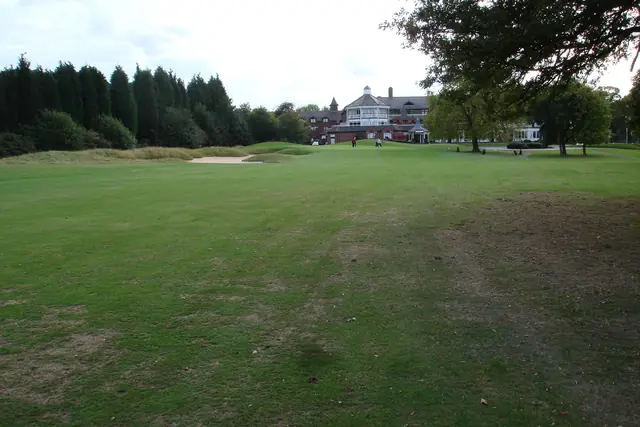
The setting brought a different visual character from the Open links familiar to many British spectators. Water, short strategic holes and a resort layout supplied recognisable match-play scenes. The tenth, associated with Seve Ballesteros's attacking play, and the closing hole associated with Torrance became recurring reference points. They are parts of a course rather than isolated television stages, so viewing them in context helps explain both the options and the risks.
Today's Brabazon is a working course with its own visitor arrangements and alterations over time. A historical visit can identify the important places without claiming that every modern yardage, bunker edge or putting surface exactly reproduces 1985. That distinction is useful whenever a memorable sporting scene survives through photographs as well as changing ground.
The match did not begin as a European procession
The Americans won the opening foursomes session 3–1. Europe recovered in the afternoon four-balls, taking that session 2½–1½, but still trailed 4½–3½ at the end of Friday. Starting with the famous Sunday putt can obscure this less comfortable beginning. The winning side had to respond to an early deficit before it could build the lead that changed the match.
Saturday moved the balance. Europe won the morning foursomes 2½–1½ and the afternoon four-balls 3–1, producing a 9–7 advantage before the singles. Those session totals explain the shape of the final day more clearly than a vague statement about momentum. A two-point lead was useful, but it left twelve singles points to contest and no guarantee that the cup would remain in Europe.
The lesson for a modern spectator is to read the match as several connected contests. An opening-session result is not a forecast of the final score. Different partnerships, decisions and individual performances can alter the balance quickly. The Ryder Cup's drama comes partly from that simultaneous activity, with each completed match changing the requirement elsewhere on the course.
More than one European hero
Manuel Piñero finished with four points from five matches, the leading return on either side. Seve Ballesteros supplied three and a half, while Paul Way contributed three. These figures are a useful corrective to a history told entirely through the best-known photograph. A player can provide a decisive share of the winning total without being the person standing over the putt that becomes the remembered climax.
The Spanish contribution also showed the significance of the wider European side. Ballesteros, Piñero, José María Cañizares and José Rivero were part of Jacklin's team alongside players from Britain and Germany. Their involvement did not diminish the British history of the competition; it changed the resources and identity of the team carrying that history forward.
Avoid calling Piñero unbeaten. One official retrospective's introductory text describes a 4–0 return, but the individual record and match results show four wins and a defeat. The four-point total is secure; the extra claim is not. Keeping that qualification in the research notes is preferable to repeating an appealing but inaccurate shorthand.
The individual season behind the team result
The European side arrived with major champions from the same season. Bernhard Langer had won the Masters in April, and Sandy Lyle had taken The Open at Royal St George's in July. The Ryder Cup therefore followed significant individual successes rather than rescuing a season in which European players had achieved little. Their presence helps explain why a stronger team challenge was plausible, even though individual titles do not automatically produce good partnerships.
Lyle's Open win also adds a second British course to a 1985-focused trip. Sandwich and The Belfry represent different kinds of golf and different competitive formats. Connecting them gives the season a broader shape without claiming that one victory caused the other.
Torrance and North at the last
Torrance faced the reigning US Open champion Andy North in the singles. The match reached the eighteenth, where North's drive found water and Torrance went on to win one up. The putt and the response around the green supplied the visual climax of Europe's breakthrough. Different accounts give slightly different measurements for the putt, so its importance does not depend on selecting an unsupported exact length.
Europe won the singles 7½–4½ and the overall match 16½–11½. That wider margin belongs beside the individual conclusion. Torrance's point settled the team's immediate objective, but several matches contributed to the eventual score. A final scoreline and the point at which victory becomes certain are related facts, not the same instant.
The emotion was understandable after the long interval since 1957. It should be described through the documented result, images and published recollections, rather than invented private thoughts. The arms raised on the green are eloquent enough without adding words that were never recorded.
What changed after 1985
Europe won away at Muirfield Village in 1987, then retained after a draw at The Belfry in 1989. Those later results gave the 1985 victory a place in a sustained competitive change rather than leaving it as one exceptional home week. Yet the breakthrough should not be used to imply that Europe would thereafter win automatically. The United States recovered the trophy in 1991 and won again at The Belfry in 1993.
The course's final Ryder Cup staging, in 2002, brought another European victory under Torrance as captain. A visitor can therefore connect the 1985 player with the 2002 captain while keeping the two editions distinct. The Belfry history, venue guide and accommodation advice provide the next steps for that journey. Start with the particular year that interests you, then use the wider course story to understand why several generations recognise the same holes.
Sources and useful official links
- Confirmed: official complete historical results
- Confirmed: Ryder Cup account of Jacklin's captaincy
- Confirmed: official 1983 retrospective
- Confirmed: official player table
- Confirmed: The Belfry's course history
- Confirmed: independent detailed match scores
- Reported: independent individual results
- Reported: Golf Monthly on Piñero's return
- Confirmed: official 1985 Open archive
- Confirmed: DP World Tour on Langer's first Masters
- Confirmed: Ryder Cup's fortieth-anniversary account
- Reported: independent 1985 result account
Useful reading for your visit
Visit today
- The Belfry visitor guide
- Ryder Cup 2027 at Adare Manor
- Where to stay for the British Masters: Sutton Coldfield and Birmingham
Some links earn us a small commission at no extra cost to you. Affiliate disclosure.