
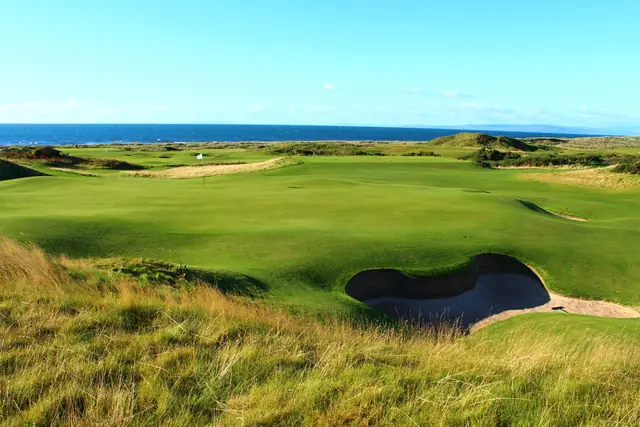

The story and its setting
Tom Watson won five Opens at five different courses in nine years. That record is the foundation of his relationship with British links golf, but it is not the whole story. The same career includes the championship’s final eighteen-hole play-off, the Duel in the Sun, a commanding win at Muirfield and an attempt to become champion again at 59. Later appearances and senior championships extended the connection far beyond his first run of success. A Watson journey is therefore a tour of different competitive problems, rather than five versions of the same winning afternoon.
His Open victories came at Carnoustie in 1975, Turnberry in 1977, Muirfield in 1980, Royal Troon in 1982 and Royal Birkdale in 1983. The sequence is set out in the championship results. It accounts for five of his eight major titles, alongside two Masters and the 1982 US Open. Those wider achievements help explain his standing, while the British courses provide the geographical focus of this history.
Carnoustie: a major on his Open debut
Watson’s first appearance in The Open ended in victory at Carnoustie in 1975. He was 25, and the championship did not unfold as a straightforward procession towards a familiar favourite. David Huish, the North Berwick club professional, led at halfway. Bobby Cole and Jack Newton then helped set the pace. Watson reached the last hole of the final round needing something decisive and holed a birdie putt to reach eleven under par.
Newton also finished on that total, sending the contest to an eighteen-hole play-off. In rain, the two remained level as they played the final hole. Newton’s approach found a bunker; Watson made par and won the play-off 71–72. The extra round was played on Sunday because the championship itself had concluded on Saturday. It became the last eighteen-hole play-off in Open history. Describing it as a modern four-hole aggregate contest would change the sporting task Watson and Newton actually faced.
The result established two enduring parts of Watson’s story: an ability to recover during a difficult final round and a successful response to another day of pressure. Carnoustie was not simply a welcoming first stop. It required him to win a separate contest after the four championship rounds had failed to divide the leading pair. The course history follows that finish among the other Opens staged on the Angus links.
Turnberry: the Duel in the Sun
Watson’s second title came at Turnberry in 1977, the course’s first Open. He and Jack Nicklaus moved clear of the rest of the field during the final two rounds. Watson shot 65 and 65 over those rounds; Nicklaus returned 65 and 66. Their totals were 268 and 269. The one-stroke margin explains the close contest, while the distance back to the next player explains why the championship is remembered through the two men rather than as a crowded final-day chase.
The last hole supplied the decisive contrast. Watson hit his approach close enough to set up a short birdie chance, while Nicklaus recovered from trouble and holed a long birdie putt of his own. Watson still had to complete his putt to win. That sequence is more informative than treating the championship as settled by one earlier brilliant shot. Nicklaus kept the contest alive, and Watson answered on the final green.
The separate Duel in the Sun account follows the finish in detail. Within Watson’s career, its place is clear: a second Open, on another course, won by surviving direct competition with one of the game’s defining champions. It was a different test from the eighteen-hole decider at Carnoustie, even though both came down to a narrow margin.
Muirfield: winning from the front
At Muirfield in 1980, Watson won by four strokes from Lee Trevino. The key third-round 64 gave him a four-stroke advantage, and a closing 69 completed a total of 271. That Sunday included five birdies in six holes from the seventh. The performance demonstrated another way to win: establishing the lead through exceptional scoring, then continuing to make birdies rather than merely protecting the original cushion.
The field provided a useful comparison. Isao Aoki shot 63 in the third round, yet Watson’s own 64 and his position over the week kept him in command. A single outstanding round and a championship-winning aggregate are separate achievements. Trevino, the 1972 Muirfield champion, finished second, while Jack Nicklaus, who had won there in 1966, shared fourth. Watson’s victory therefore came on ground already associated with major rivals and earlier champions.
His third Claret Jug also complicates the popular idea that Watson always won through a desperate last-hole intervention. Muirfield was controlled golf across several rounds. The course history places it alongside the other championships played there, including a very different pair of victories by Nick Faldo.
Royal Troon: taking an opening
Watson arrived at Royal Troon in 1982 after winning that summer’s US Open at Pebble Beach. The Troon championship initially seemed to belong to Bobby Clampett, who led by five at halfway and moved seven ahead during the third round. His advantage disappeared over the closing two rounds. Nick Price then became a leading contender, but errors on the final nine holes changed the contest again.
Watson’s own final round contained an eagle at the eleventh, where he hit a three-iron close to the hole. He finished with 70 and a four-under-par aggregate, one stroke ahead of Price and Peter Oosterhuis. The result was not a replay of Muirfield’s commanding four-stroke win. It rewarded Watson’s continued presence as the leaders changed and the weather made the finish demanding. He had converted another opportunity on a fourth different Open course.
Royal Birkdale: the fifth championship
The fifth win came in England, at Royal Birkdale in 1983. Watson led after three rounds but lost ground going out on the final day. Birdies at the eleventh, thirteenth and sixteenth brought him back into the position he needed. Andy Bean and Hale Irwin had posted eight under par, leaving Watson needing a par at the last to win outright.
From 218 yards, he struck a two-iron onto the final green and two-putted. His total of 275 was one stroke better than Bean and Irwin. The approach deserves its place among the remembered shots of his career because it answered a precise competitive requirement: find the green and preserve the winning margin. This completed five Open wins between 1975 and 1983, putting Watson alongside the championship’s other five-time winners.
The sixth title that did not come
Watson came close again at St Andrews in 1984, but Seve Ballesteros won. Watson’s bogey at the Road Hole became part of the final-day story, linking his career to a famous championship feature at a course where he never won The Open. It is an important distinction for visitors: a player’s significant venues include defeats as well as victories.
The most remarkable late challenge came at Turnberry in 2009. At 59, Watson led after three rounds and reached the final hole needing a par for victory. His approach ran through the green; he could not complete the par, and Stewart Cink joined him in a play-off. Cink won the four-hole aggregate contest. The achievement of reaching that position should not be rewritten into a sixth title, but neither does the final result describe how extraordinary the preceding four days had been.
A connection beyond the five wins
Watson also won three Senior Opens, at Turnberry in 2003, Royal Aberdeen in 2005 and Muirfield in 2007. Those were separate senior championships, not additions to his five men’s Open victories. As a Ryder Cup captain, he led the United States to victory at The Belfry in 1993 and returned to the role at Gleneagles in 2014, when Europe won. The British and Irish golfing landscape consequently contains several different parts of his career.
For an initial history-minded visit, combine the Turnberry story with one other championship setting rather than trying to collect all five winning venues at once. The current venue guides explain access and the Open visitor hub covers attending the next championship. Watson’s record gives each location a story to follow; the different rounds, weather and opponents explain why those stories deserve more than a shared entry on a list.
Sources and useful official links
- Confirmed: Official and historical background
- Confirmed: Official and historical background
- Confirmed: Official and historical background
- Confirmed: Official and historical background
- Confirmed: Official and historical background
- Confirmed: Official and historical background
- Confirmed: Official and historical background
- Confirmed: Official and historical background
- Confirmed: Official and historical background
- Confirmed: Official and historical background
- Confirmed: Official and historical background
- Confirmed: Official and historical background
- Confirmed: Official and historical background
- Confirmed: Official and historical background
Useful reading for your visit
Visit today
- Trump Turnberry: a visitor’s guide
- The Open 2027 at St Andrews
- Where to stay for Troon and Ayrshire golf
Some links earn us a small commission at no extra cost to you. Affiliate disclosure.