

The story behind the championship
Seve Ballesteros's British golf story can be followed through three courses and one team competition. Royal Birkdale introduced a nineteen-year-old Spaniard to a much wider audience in 1976. Royal Lytham & St Annes supplied two Open victories, and St Andrews supplied the third, with the final-green celebration that remains one of golf's most recognisable images. The Ryder Cup then gave his individual imagination a collective purpose. His achievements are large enough to explain without invented quotations, claims about what opponents privately thought or a suggestion that every recovery shot was planned from the start.
For a visitor, those connections create a practical route into his career. The courses are real places with their own histories, rather than simply scenery behind a highlights film. Looking at the ground helps explain the decisions; reading the results keeps the legend attached to what actually happened.
Royal Birkdale 1976: an arrival without the trophy
Ballesteros did not win the 1976 Open. Johnny Miller won by six strokes, with Seve and Jack Nicklaus sharing second place. That distinction is important because the young Spaniard's impact has sometimes become more familiar than the championship result. His final-round troubles were real, and his imaginative recovery at the last did not turn the week into a victory.
The nineteen-year-old led going into the final round and made a lasting impression with a chip-and-run played between bunkers at the eighteenth. It was an early example of the ingenuity that British galleries would associate with him. Rather than presenting Birkdale as a polished champion completing an expected success, the more interesting story is a talented young player holding attention even while another golfer took the title.
The course history and championship archive are useful companions here. One explains the setting; the other preserves the score. A modern visit should allow room for both perspectives, recognising the hole and its surroundings without assuming that today's course conditions reproduce the championship exactly.
Lytham 1979: creativity produces a major title
Three years later Ballesteros won at Royal Lytham & St Annes. The 1979 Open was his first major and the first of his three Open victories. He finished three strokes ahead of Nicklaus and Ben Crenshaw. The triumph also made him the first mainland European Open champion since Arnaud Massy in 1907, a useful measure of how unusual his arrival was in the championship's longer story.
His recovery from the car-park area beside the sixteenth became the memorable emblem of the week. It should be understood as a particular incident within a complete championship performance, rather than proof that wayward driving is a reliable strategy. A great recovery can rescue a situation without making the original position desirable. That tension is part of what made watching him compelling: the difficulty remained visible, even when he found an unexpected route out of it.
Lytham is therefore a better place to explore the achievement than a loose description of Seve as a magician. The course supplies the problem, the official account supplies the sequence and the final score supplies the result. The nickname becomes meaningful only after those details are understood.
St Andrews 1984: the celebration and the competition
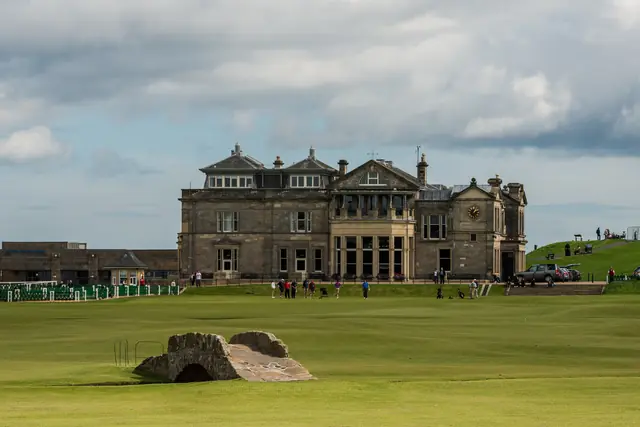
At St Andrews in 1984, Ballesteros finished on 276, twelve under par, beating Tom Watson and Bernhard Langer by two strokes. His closing birdie and repeated fist pump on the eighteenth green became an enduring picture of delight. The image matters, but it belongs to a tightly contested Open rather than a ceremonial procession around the Old Course.
Watson was pursuing another title at a venue he had not yet conquered in The Open. Ballesteros's final round and Watson's difficulties near the finish altered that outcome. The championship is best read through the score and sequence before returning to the photograph. Otherwise a complex final day becomes a single gesture detached from the shots that made it possible.
For travellers, the eighteenth and the surrounding town offer an unusually immediate connection with the scene. The setting remains recognisable without needing spectators to recreate a championship moment or step into a player's line. Follow the venue's visitor arrangements and remember that a famous public image does not make every part of a working golf course unrestricted public space.
Back to Lytham in 1988
The third Open victory came at Lytham in 1988. Ballesteros closed with 65 for a total of 273, eleven under par, finishing two strokes ahead of Nick Price. Returning to the same course links the first and last of his Open titles, but the two championships were not repetitions. The final round in 1988 supplied a different demonstration of his ability, with a sustained scoring performance rather than one recovery dominating the account.
That distinction helps avoid reducing his career to a collection of improbable escapes. Imagination was valuable because it accompanied the ability to compile winning rounds against strong opponents. A championship total is built across four days; the most replayed shot is only one contribution. Lytham's two victories make that balance especially clear.
Europe becomes a team
Ballesteros made his Ryder Cup debut in 1979, the first edition in which continental Europeans were eligible. The enlarged European side lost that match and the next two. His presence did not instantly end American dominance, which makes the eventual breakthrough at The Belfry in 1985 more significant. Seve was part of a developing team rather than a single player winning an international competition alone.
He played in eight Ryder Cups and contributed 22½ points. His partnership with José María Olazábal became the most productive in the competition's history: twelve points from fifteen matches together, comprising eleven wins, two defeats and two halves. The details show why points and victories must not be confused. Two halved matches helped the team even though neither was an outright win.
The partnership also adds another way of watching golf. The exchange between players, recovery after a partner's mistake and decisions made in alternate shot are part of the performance. Individual flair becomes one ingredient in a shared task. For visitors following the Ryder Cup's British history, The Belfry provides a particularly relevant setting for that transformation.
Wentworth: a wider British connection
The Open links are not the whole of Ballesteros's British story. At Wentworth he won the PGA Championship in 1983 and 1991, alongside five World Match Play titles on the West Course. The European Tour identifies those seven victories as his most productive return at a single venue. That makes Wentworth a substantial alternative for a visitor whose interests extend beyond the Claret Jug.
The two competitions should stay separate in the history. A PGA Championship title came from stroke play, while the World Match Play demanded progress through individual matches. Together they show different expressions of his game at the same club. They also connect his British achievements with the professional tour on which he established a fifty-win career.
Source: DP World Tour's Wentworth assessment.
Captaincy, the wider career and the places to visit
Ballesteros captained Europe to a 14½–13½ victory at Valderrama in 1997. It was the first Ryder Cup staged outside Britain and Ireland on the European side of the Atlantic. His role had changed from player to captain, but the connection with a wider European identity remained central. The captaincy belongs in his record separately from the eight playing appearances.
The DP World Tour credits him with fifty European Tour victories and five major championships. Those totals place the British highlights within a much broader career, rather than implying that three Opens were his entire achievement. His wins also sit within the expansion and strengthening of the European professional circuit. The courses in Britain are a particularly accessible route into that history for this site's readers, but not its geographical limit.
Plan a Seve-focused trip by choosing one strong connection rather than racing between every associated venue. Birkdale shows the breakthrough in public attention; Lytham connects two winning championships; St Andrews connects the final-green image with the Old Course; The Belfry explains his contribution to a team. Use the course history, present-day venue guide and accommodation advice together. Historical understanding makes the visit richer, while current arrangements make it possible.
Sources and useful official links
- Confirmed: official 1976 Open account
- Confirmed: Royal Birkdale's history
- Confirmed: official 1979 championship history
- Confirmed: R&A's account of the 1979 recovery
- Reported: Sky Sports retrospective
- Confirmed: official 1984 championship archive
- Confirmed: R&A's 1984 retrospective
- Confirmed: official 1988 account
- Confirmed: official Open player record
- Confirmed: official Ryder Cup Seve retrospective
- Confirmed: official partnership record
- Confirmed: Ryder Cup: Europe's most successful partnership
- Confirmed: DP World Tour's Wentworth assessment
- Confirmed: official European Tour player record
- Confirmed: Ballesteros's official biography
- Confirmed: official complete Ryder Cup results
Useful reading for your visit
Visit today
- St Andrews Old Course visitor guide
- The Open 2027 at St Andrews
- Where to stay for The Open 2027 at St Andrews
Some links earn us a small commission at no extra cost to you. Affiliate disclosure.